Ticketing & support10 min
Onboarding a new agent without grinding your team to a halt
Sep 13, 2026
Opening a channel is easy, staffing it isn't. This article explains what chat, email and phone are genuinely good at, the expectations each one sets, and why more channels without one shared view actually make your service slower.
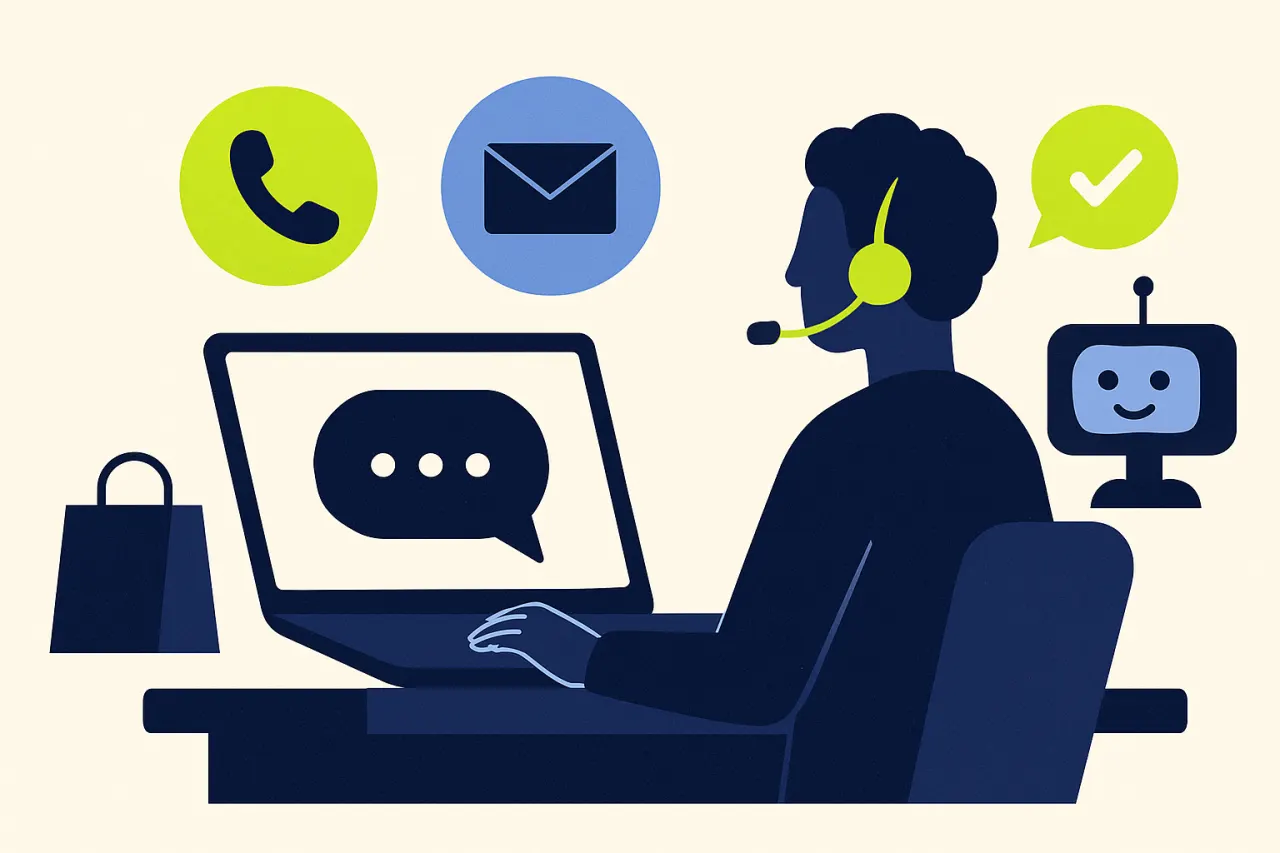
The question of which channel to offer is rarely answered deliberately. In practice the mix just grows. The email address was already there. A phone number came next. Then a chat widget, because a competitor had one. And by now something occasionally arrives via WhatsApp too. Nobody ever decided this was the right mix.
That's more problematic than it seems, because every channel you open sets an expectation you have to meet. A chat window saying 'we're here for you' that only responds after twenty minutes does more damage than no chat window. A phone number that often goes unanswered undermines trust more than a page stating you're only reachable by email.
This article covers what each channel is genuinely good at, the costs and expectations attached, and how to choose which ones to offer. It isn't about having as many channels as possible, but about being able to deliver on the ones you have.
Phone is the fastest channel for complexity and emotion. An angry customer, a situation needing explanation, a misunderstanding resolved in three sentences back and forth: that works better by phone than in text. It's also synchronous, so there's no room for waiting and misinterpretation in between.
Against that, phone is the most expensive channel per query and the worst at scaling. One agent can handle one conversation. There's no way to work in parallel, a queue forms the moment things get busy, and the information from the call disappears if nobody records it. That last point is the most underestimated cost: a problem solved by phone that leaves no trace has to be worked out again at the next follow-up.
Email is the opposite. It scales excellently, distributes well across a team, and automatically produces a record. The customer can compose calmly and attach files, and the agent can investigate before answering. For anything requiring lookup, email is the most suitable channel.
Email's weakness is elapsed time. A question finished in one phone call can take three days by email because every round contains waiting. For a simple question the customer experiences that as slow, even though total working time was shorter.
Live chat sits in between, and that's precisely its strength. It's fast enough to save a purchase moment, but textual enough to work in parallel and build a record. That makes chat strongest at moments when the customer is about to make a decision: a sizing question just before checkout, doubt about delivery time in the basket.
Customers apply completely different time expectations per channel, and that expectation determines whether they rate your service well or badly, regardless of how hard you work.
With chat the expectation is near-instant. The window suggests presence, so a reply after ten minutes feels like being ignored. With email the bar sits at hours, and most customers accept a response within a working day without complaint. With phone the expectation is being picked up within a minute, and a longer wait is experienced as rude faster than a slow email.
The consequence is that you should only open a channel if you can structurally meet the matching expectation. Offering chat while nobody is staffing it during the busiest hours guarantees dissatisfaction. It's better to show chat only when there's coverage than to display it always and make people wait often.
The same logic applies to promised response times. A page promising 'an answer within 24 hours' while it actually takes two days produces disappointed customers every single day. A promise of two working days that you always meet produces a much better verdict, even though the promise is worse on paper. This is one of the few places in customer service where promising less measurably delivers better results.
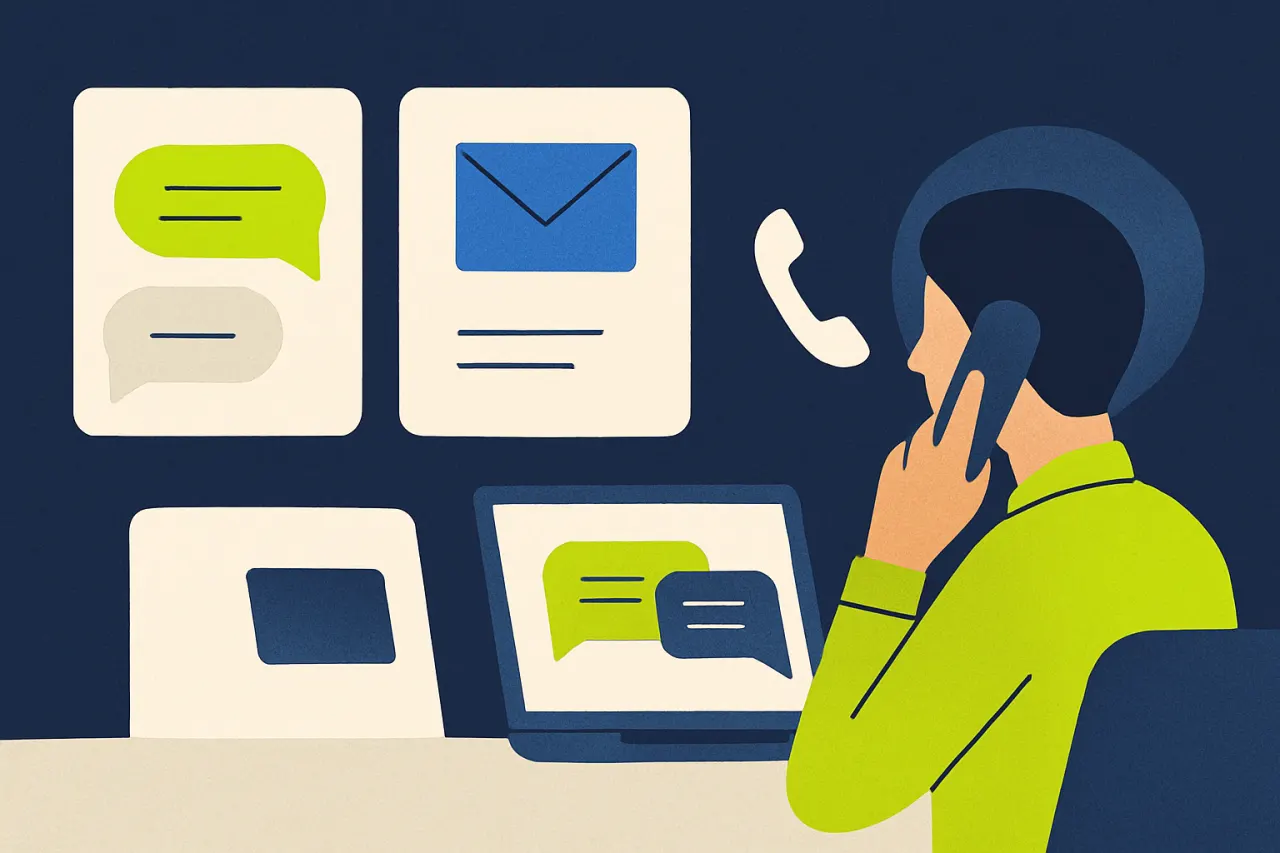
Most teams adding a channel expect the work to spread out. In practice something else happens. Total volume rises, because a lower barrier produces more questions. And the work fragments across more places someone has to watch.
That fragmentation is the real cost. An agent juggling three tabs loses time switching and misses signals. Worse, the same customer can arrive via two channels without anyone noticing: first an email, then impatiently via chat. Two agents then investigate the same thing, potentially give different answers, and the customer concludes the company doesn't have its act together.
So the first question when expanding channels isn't whether you can handle the channel, but whether it lands in the same view as everything else. If it all converges into one workflow with one history per customer, an extra channel is mainly extra volume, and volume can be planned for. Give the channel its own inbox and you're buying permanent coordination work that never goes away. We covered that mechanism in more depth in our article on the shared inbox for email, chat and phone.
The practical advice is therefore boring but effective. Only add a channel once the existing offering is in order. Make sure the new one lands in the same workflow from day one. A channel you plan to integrate later rarely gets integrated.
The choice follows from two things: what you sell, and when the customer hesitates.
If you sell low-price, high-volume products, short repeated questions dominate. Chat and good self-service do most of the work there; phone is an expensive channel for questions that don't need it. If you sell something expensive, complex or bespoke, phone isn't a cost but a sales instrument. A B2B customer weighing a quote wants to speak to someone.
Also look at the moment of hesitation. If it arises before the purchase, chat deserves priority, because revenue is directly attached. If the doubt comes afterwards, around delivery or returns, the bigger win lies in removing the question through status information rather than adding a channel to answer it.
A final consideration is staffing. Synchronous channels demand predictable presence; asynchronous ones can be spread across the day. A small team is therefore often better off with a strong email channel plus chat during set hours than with all three half-staffed. Distributing limited coverage honestly across fewer channels almost always earns a better verdict than being slightly present everywhere.
And remember the mix isn't a permanent choice. Channels may move with season and volume. Turning off chat during a period you can't staff it isn't a retreat but a deliberate choice to deliver on the expectation you can still meet.
There's information in the channel choice itself that most teams leave on the table. A customer who calls about something that could easily have been an email is saying something. They don't trust it, they're in a hurry, or they got an answer earlier they couldn't use.
Rising phone volume while your email volume stays flat is therefore rarely a phone problem. Usually it's a symptom of something else: emails answered too slowly, answers that don't close the question, or ambiguity in a process people want certainty about. The channel shifts to wherever customers believe they'll actually be helped.
The same applies within a single conversation. A customer asking for a phone number during a chat is signalling the subject has become too complex for text. Facilitating that switch is cheaper than resisting it: a five-minute call often prevents a half-hour chat that ends with a call anyway.
So measure not just volume per channel but the shifts between them. Those shifts tell you where trust in your service sits and where it falls away. That steers better than the absolute number of contacts per channel.
A question that returns in every channel discussion is whether you should be reachable evenings and weekends. The answer depends on when your customers buy, not on when your team works.
In most webshops a considerable share of orders falls outside office hours, simply because that's when people have time. The questions that come with them arise at that same moment. Responding only between nine and five leaves the evening customer's hesitation standing overnight, and part of that hesitation becomes a cancelled order in the meantime.
That doesn't mean you need an evening shift. There are cheaper ways to cover those hours: good self-service, an automated first response handling the standard questions, and a clear notice of when a human is back. What doesn't work is silence: a contact form that confirms nothing and gets answered the next day feels like a message into a void.
Then be explicit about your availability and stick to it. Customers accept limited hours without complaint, provided they know them in advance. What costs trust is a channel that looks available and turns out not to be.
Opening a channel costs nothing, but the expectation it creates has to be met again every single day. That is the real price of an extra channel.
Cuego
cuego.io
Your Cue to Go.
The Customer Contact Platform where conversations, customer data, knowledge, workflows, people and AI come together. Book a 30-minute demo and see it against your own situation.
30-minute demo · then we set it up together
Rather look for yourself first? Take the free website scan
See also
Everything in Cuego connects. Discover the modules, solutions and integrations that belong with this.