AI & Automation9 min
Automating customer service: where do you start?
Oct 24, 2025
An AI agent in customer service is neither a magic box nor a gimmick. This article sets out honestly what an AI agent handles independently today, where the limits lie and how to divide the work between AI and people so that quality goes up rather than down.
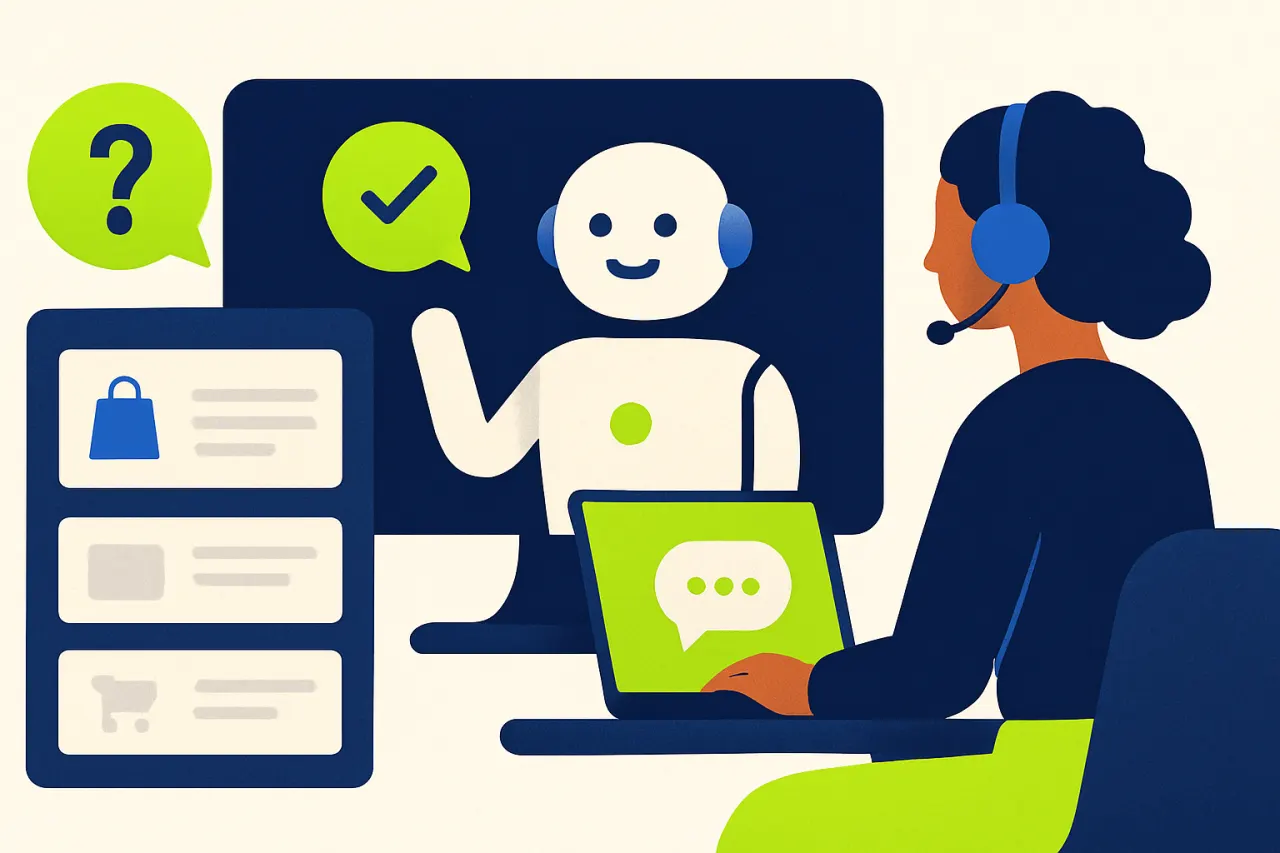
An AI agent in customer service is software that independently understands customer questions, retrieves the right information and formulates an answer, without an agent directing every step. Unlike a classic chatbot, which works with fixed menus and keywords, a modern AI agent reads the question in natural language, reasons about the context and connects to systems such as the webshop, the CRM and the knowledge base. That difference is the source of much confusion: anyone judging an AI agent by the disappointments of old chatbots is comparing apples to oranges.
At the same time, the opposite is just as harmful. The expectation that AI takes over everything and makes the team redundant leads to poor choices and angry customers. This article therefore takes a sober middle path. It describes what an AI agent can genuinely do on its own today, where the hard limits lie, and above all how to design the division of work so that AI absorbs the dull volume and people do what only they can do. That is not a philosophical question but a design question with concrete answers.
The reason this question matters now is that the technology has taken a leap. Where a chatbot a few years ago could only walk through a pre-built decision tree, an AI agent today can interpret a running sentence, ask follow-up questions, and weave the result of a system integration into an answer. That capability shifts the question from whether it can be done to where it is wise to do it. And the latter is no longer a technical matter, but a choice about responsibility, risk and customer experience.
For a customer service team under pressure, the temptation is strong to skip that choice and simply put everything on the AI. That is exactly the mistake this article aims to prevent. An AI agent only delivers value once you decide in advance which work it gets and which work stays with people. Do that design well and you see wait times fall and satisfaction rise. Skip it and you trade a mountain of repetitive work for a mountain of correction work. The difference lies not in the model, but in the scoping.
Most disappointments around AI in customer service stem not from the technology but from wrong expectations. Two extremes dominate. On one side, over-optimism: the idea that a single button solves every question and the team can shrink. Anyone who starts that way sets the AI loose on everything, watches it stumble over exceptions and concludes that AI does not work. On the other side, cynicism: the memory of a chatbot that years ago only said ‘I did not understand that’. Anyone who starts that way dares trust the AI with nothing and misses the gains that are achievable.
Both pictures miss the point. An AI agent is neither a replacement nor a gimmick, but a colleague with a very specific profile. It is unbeatable at repetition, speed and availability, and weak at judgement, empathy under high tension and reading what a customer truly means when they are vague. A team that knows this profile deploys the AI on the tasks where that profile excels and keeps people free for the rest.
The cost of a wrong expectation is concrete. Too much trust leads to wrong answers that damage customer trust. Too little trust leaves a mountain of repetitive work that exhausts people and drives up wait times. The right question is therefore not whether you deploy AI, but for what exactly.
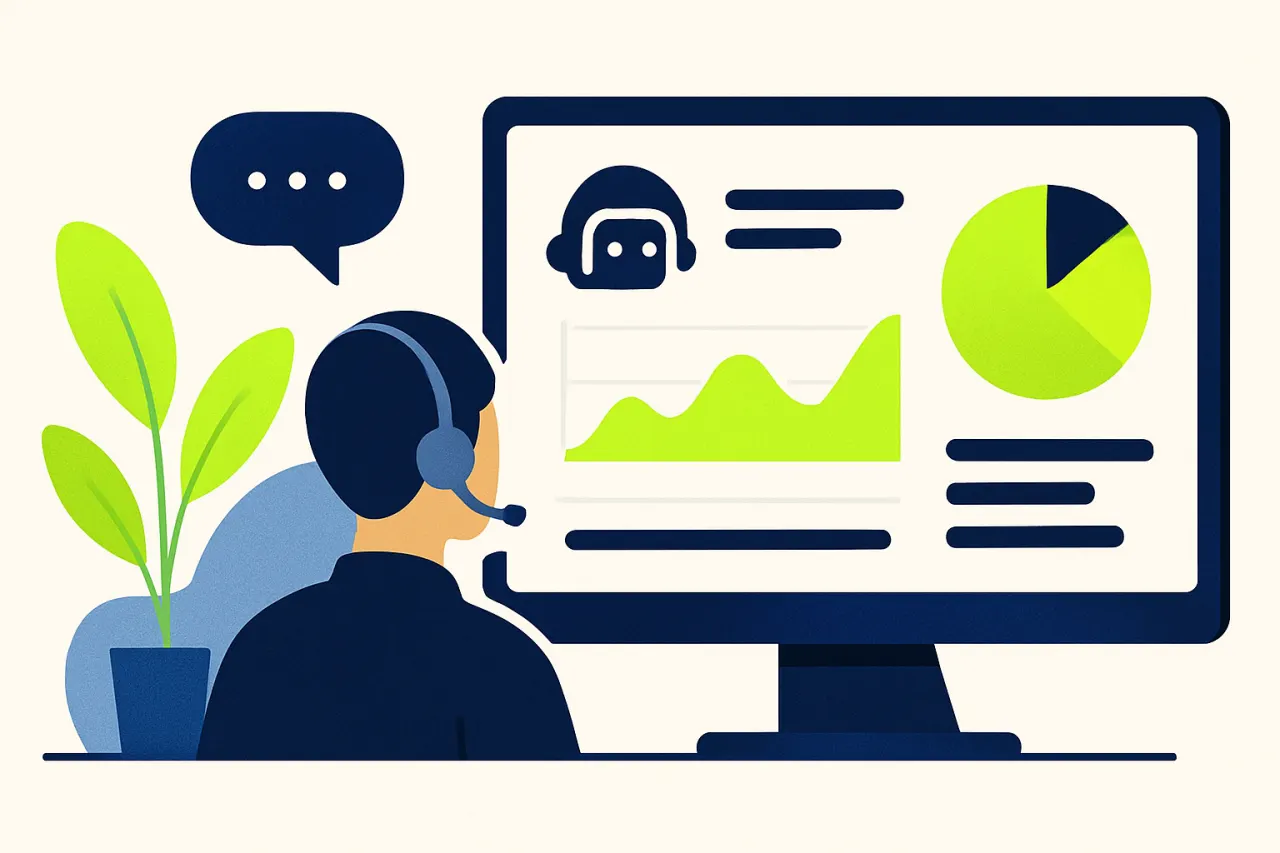
The art is to split the inbox into work that can be standardised and work that requires judgement. AI takes the first, people the second. That is not a compromise but the way the quality of both rises.
To design the division of work, you need to know the strengths and weaknesses. Below first four things a modern AI agent handles independently and reliably, then three where the limit lies.
Questions that arrive hundreds of times a month in every webshop are the natural domain of the AI. Delivery status, opening hours, return policy, warranty terms, product specifications: these are questions with one correct answer that lives in the knowledge base or a connected system. The AI fetches that answer, phrases it in your tone of voice and delivers it instantly, day and night, in every language you have set up.
The gain here is often underestimated. It is not the hard questions that exhaust a service team, but the flood of easy ones. Explaining the return window ten times a day eats up attention you would rather spend on the difficult cases. By putting that volume on the AI, the team gets back not only time but also focus. And because the answer comes from one managed source, every customer gets exactly the same correct story, without the small deviations that creep in when five agents recite it from memory.
An AI agent connected to your systems can do more than repeat information. It recognises the customer, looks up the right order, reads the current delivery status and combines that into a personal answer. ‘Where is my order?’ is then answered not with a generic story but with the real status of that one order. That is exactly the kind of lookup work that costs people a lot of time and that an AI does in seconds.
The difference with a static answer is large. A customer told ‘delivery usually takes three to five days’ is left with uncertainty, whereas ‘your parcel was shipped yesterday and arrives tomorrow’ genuinely closes the question. The better the integrations, the more of these questions the AI can fully resolve without a human having to step in. This is often where the biggest, least visible time saving sits.
Even where the AI does not answer itself, it adds value. It summarises a long conversation, recognises the topic, pulls in the relevant customer history and proposes a draft reply. The agent does not start from zero but from a ticket that is already read, categorised and supplied with context. The human work becomes faster and more consistent.
This role as an assistant is perhaps the most underrated. Many teams immediately think of fully autonomous handling, while the biggest daily gain lies in an AI that does the heavy reading and leaves the decision to the human. An agent who sees a clean summary and a draft on every complex ticket works more calmly, makes fewer mistakes and keeps more energy for the conversations that truly matter.
An AI agent reads the tone and content and decides where a question should go. An angry customer threatening to cancel moves up the queue, a simple address change to the right handling, a billing question to the right team. That triage is invisible but largely determines how smoothly a service department runs.
Where a question has no single answer but a trade-off, a human belongs. An exception to the return policy for a loyal customer, a goodwill arrangement after a complaint, a sensitive legal matter: these are decisions where context, responsibility and human judgement come together. An AI may prepare and advise here, but not decide on its own.
The reason is not that the AI cannot frame the trade-off, but that responsibility for the outcome belongs with a person. Goodwill is an investment in a customer relationship, and that choice calls for someone who knows the context of that relationship and can carry the consequences. An AI that starts settling on its own creates precedents you do not control. The right role is for the AI to lay out the facts and the options cleanly, so the human can decide quickly and well.
A customer who is genuinely angry, sad or panicked wants to be heard by a human. A technically correct answer from an AI feels cold at such a moment and increases frustration. The AI should recognise this and hand the conversation to an agent, with the full context already prepared, rather than stubbornly continuing to answer.
An AI agent can only answer reliably on what is in its knowledge source. A brand-new product without documentation, a policy change not yet recorded, a question about something the company simply has not decided yet: here the AI must honestly flag its limit and hand over, not guess. The difference between a good and a dangerous AI deployment lies exactly here: in honestly recognising what it does not know.
An AI that prefers a plausible sounding guess over admitting it does not know is more dangerous than no AI at all. One confidently wrong answer about, say, a warranty term can mislead a customer and undermine trust in all your following answers. A well-configured AI therefore treats its own uncertainty as a signal to hand over, not as a gap to fill creatively. That honesty is not a weakness but exactly what marks a reliable deployment.

The technology is rarely the problem. The setup is. The three most common mistakes:
A good AI deployment is designed in layers, not as one big switch. Start with an inventory: collect a month of tickets and sort them into categories. Which questions occur most often, and which have a single answer? That top forms the first list of what you safely leave to the AI. This step takes half a day of work, but it prevents the most common mistake: setting the AI loose on an inbox you do not know yourself.
Then do not put the AI live to the public immediately, but first let it propose draft answers that an agent reviews. That way you see in practice where it is strong and where it is off, without risk to the customer. Questions the AI consistently answers well you then let it handle independently, step by step. Questions where it hesitates or falls outside its knowledge stay with the team. This draft phase is not lost time but a measuring instrument: you gather evidence about where the AI can be trusted, rather than guessing it.
The third design principle is the safety net. Define explicitly when the AI must stop and hand over: on high emotion, on a question outside the knowledge source, on a request for an exception, on a repeated attempt that fails. An AI that knows its own limit and hands over cleanly is more valuable than an AI that attempts everything. The handover must be seamless: the agent who takes over should already have the whole conversation and context ready, so the customer does not have to tell their story again.
Finally, make the knowledge source and the scoping a continuous process, not a one-off setting. Maintain the knowledge source actively, because every outdated rule is a wrong answer in the making. Look back periodically as well: which questions did the AI hand over that it could actually have handled, and which did it handle where a human would have been better in hindsight? By reviewing those two lists each month, the boundary slowly shifts the right way. That way the share the AI safely handles on its own grows, without ever trading quality for volume.
A classic chatbot works with fixed menus and keywords and can only follow routes that were programmed in advance. An AI agent reads the question in natural language, reasons about the context and connects to systems such as the webshop and the CRM to give a personal answer. The experience is therefore much closer to a conversation with a person.
An AI agent is neither a miracle cure nor a gimmick, but a colleague with a sharp profile. The gain lies not in whether you deploy AI, but in how well you design the division of work: AI for the large volume of repetition and lookup, people for judgement, goodwill and emotion. An honest safety net and a current knowledge base are not extras here, but the core of a safe deployment.
Want to see where the limit lies for your situation? Explore how Cuego’s AI agents work, read why an AI agent differs from a chatbot, and look at the role of a strong knowledge base in reliable answers. Or request a demo and see it applied to your own questions.
Cuego
cuego.io
Your Cue to Go.
The Customer Contact Platform where conversations, customer data, knowledge, workflows, people and AI come together. Book a 30-minute demo and see it against your own situation.
30-minute demo · then we set it up together
Rather look for yourself first? Take the free website scan
See also
Everything in Cuego connects. Discover the modules, solutions and integrations that belong with this.