AI & Automation11 min
AI agents in customer service: what they can and cannot do
Jun 21, 2026
An AI chat on your website can do exactly as much as you give it access to. Answering from your own texts, looking up orders, carrying out an action and handing over to a person in time: each layer needs different access. The question test shows which layer your site needs.
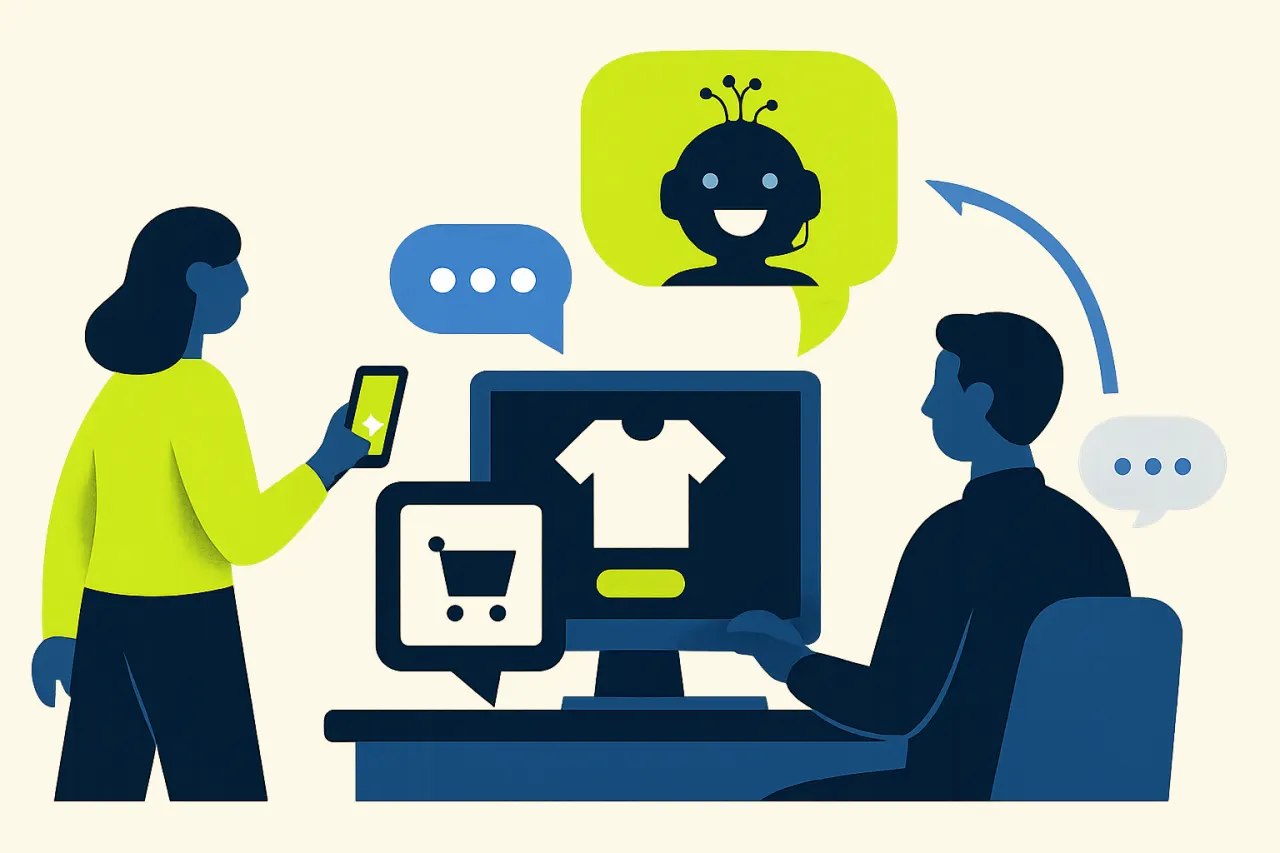
An AI chat on your website can do exactly as much as you give it access to. The language model decides how smooth an answer sounds. What that answer contains depends on what the chat may read, look up and carry out. Two webshops using the same model can end up with a completely different product on their site.
So start with your own customer questions rather than a feature list. Every question needs a certain kind of access. That access falls into four layers.
The layers build on each other. A chat that can look things up but doesn't know your return window helps the customer halfway. A chat that can act but doesn't know when to hand over is a risk.
What an AI chat can do = what it may read + what it may look up + what it may carry out + when it hands over.
More than you might expect, as long as those texts are right. Questions about shipping costs, delivery times, returns and payment have a fixed answer. That answer usually already sits somewhere on your site. The chat brings it forward the moment a visitor asks, even when they phrase the question quite differently from your FAQ.
The weak spot is the source. On a webshop we scanned, the returns page stated a 100-day window. Elsewhere on the same site it said the withdrawal period was 30 days. Legally the two can coexist. Nowhere did the site explain how. A chat reading both texts then has to choose. If it picks wrong, you've promised something you didn't mean.
A good chat therefore says so when it doesn't know. A chat that gives a smooth answer despite doubt is more dangerous than no chat at all. The mistake only shows once a customer holds you to it. How to get that source in order is covered in the knowledge base as the foundation for AI answers.
A question about an order has no fixed answer. The answer differs per customer and per hour. Without a connection, a chat can only point elsewhere: to the tracking link in the confirmation email or to the contact form. The customer then has to take another step for a question they just asked.
With a connection, the chat asks for the order number, looks up the order and returns the status your system holds at that moment. Someone asking where their parcel is usually wants to know whether it arrives tomorrow and what to do otherwise. So mention the expected delivery day too, and what the customer can do once it has passed. More on that in reducing WISMO questions.
The same layer covers product questions. Is this item in stock? Does this filter fit my appliance? Does this size run small? With access to your product catalogue, the chat answers with the data your webshop itself uses. Without that access it guesses.
Only let the chat show order details once order number and email address belong together. An order number on its own is too easy to guess.
Acting is where the most is to be gained and where the most risk sits. An address change the chat carries out itself saves an email back and forth. Nobody needs to log into the webshop for it either. A cancellation on the wrong order costs more than it saves.
So don't give a chat an independent right to an action before it has spent a while only proposing that action. Have a colleague approve every proposal and count how often they have to change something. If that number stays low, approval can come off for that one action. Refunds don't belong on that list for now. How to measure this is covered in measuring the edit rate and approval up front.
Some conversations belong with a person, however good the chat is. A complaint coming back for the second time. A question with a legal side to it. A customer who is angry and lets it show. There, a fast answer helps less than someone who can decide.
Handing over only works if the colleague receives the conversation with everything in it. If the customer has to tell their story again, the chat was a detour. Also decide up front which topics the chat stays away from. For price agreements or medical claims it then refers on straight away.
Outside opening hours nobody can take over. The chat should then say honestly when someone will be looking again, and record the question so it is ready the next morning.
A chat isn't an improvement for every site. In three situations it adds little:
Take the last fifty customer questions that came in by email, chat or phone. Mark for each one which layer it needs: knowing, looking up, acting or handing over.
A site with mostly knowing questions can start tomorrow. A site with mostly lookup questions starts with the connection.
The knowing layer is as strong as the texts on your site. The Cuego scan reads your website the way a chat would. It shows which frequently asked questions have a complete answer, where information is missing and where pages contradict each other.
Cuego
cuego.io
Your Cue to Go.
The Customer Contact Platform where conversations, customer data, knowledge, workflows, people and AI come together. Book a 30-minute demo and see it against your own situation.
30-minute demo · then we set it up together
Rather look for yourself first? Take the free website scan
See also
Everything in Cuego connects. Discover the modules, solutions and integrations that belong with this.