AI & Automation9 min
Automating customer service: where do you start?
Oct 24, 2025
The biggest hesitation about AI in customer service isn't whether it works, but what happens when it doesn't. This article explains which risks are real, which are overstated, and how approval, boundaries and logging let you deploy AI safely without losing control.

Every conversation about AI in customer service eventually arrives at the same question: what if it goes wrong? What if the AI promises a wrong discount, applies an incorrect return rule, or gives a customer an answer that doesn't match policy? That hesitation is reasonable. An AI communicating with customers on its own can in theory make mistakes a human could also make, but potentially faster and at greater scale.
At the same time, this risk is often portrayed as bigger than it is in practice, and the comparison to a human team is rarely made fairly. Agents make mistakes too: a wrong answer, a missed nuance, a promise that shouldn't have been made. The difference isn't whether mistakes happen, it's how visible, recoverable and controllable they are.
This article is about managing the risk concretely. Which boundaries do you set in advance? Where do you build in approval? And how do you catch mistakes quickly enough to fix them before they cause damage?
It helps to treat risk as more than one concept. The chance something goes wrong, the damage when it does and how far you can undo it are three different things, and they call for different measures. A frequent but trivial error is worth solving with better content. A rare but irreversible one is worth blocking before it can happen.
Not every risk carries the same weight. An AI that strikes a slightly too formal tone is annoying but harmless. A different level of risk appears once the AI acts on its own. A refund outside policy, the wrong personal data shared, a promise the business can't keep. The distinction that matters is whether a mistake is reversible and whether it has financial, legal or privacy consequences.
Repeatable, factual questions like order status or shipping information carry a low risk profile: the answer is objectively verifiable and a mistake usually has no lasting consequence. Questions involving money flows, policy exceptions or sensitive data deserve a higher risk rating and therefore more control. By categorizing risks this way, you can decide precisely where AI may act fully independently and where a human should review first.
There's one risk category that's often missing from lists like this and occurs most in practice: the confidently invented answer. An AI that honestly says it doesn't know is awkward but safe. An AI naming a plausible-sounding return window recorded nowhere causes damage precisely because the answer is credible. Both the customer and the agent who picks up the conversation later assume it's correct.
That makes the source of an answer more important than its phrasing. An answer demonstrably traceable to a recorded policy document is verifiable; one based on general knowledge isn't, however well it reads. This is why the quality of your knowledge base says more about your risk in practice than the choice of a particular model.
The most effective way to manage risk isn't trusting AI less, it's defining in advance exactly what may be autonomous and what may not. That's not a technical detail, it's a policy choice you make as a business. Questions about order status, opening hours or standard policy can perfectly well be answered fully automatically. Exceptions to the return policy, refunds above a certain amount, or legally sensitive topics you can deliberately keep out of automatic handling.
These boundaries aren't static. As you build trust and see which categories of questions the AI consistently handles well, you can gradually push the boundaries further. Conversely, you can tighten a boundary immediately once a category of questions goes wrong more often than expected. The point is that you set that boundary, not the AI itself.
The risk of AI in customer service is largely determined in practice by how you introduce it. The exact same technology is manageable or unmanageable depending on whether you release it onto all your customer contact at once or expand step by step.
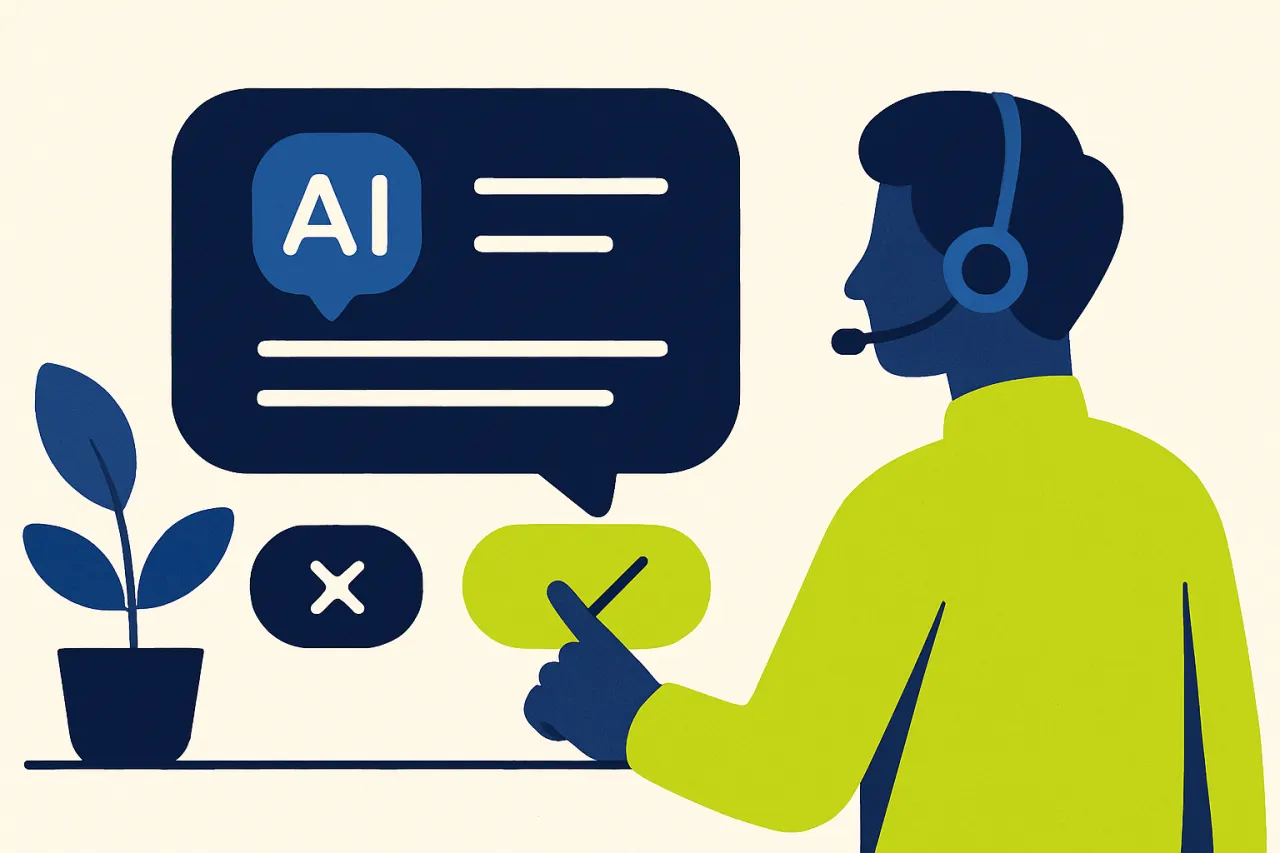
A proven sequence starts without customer contact at all. First let the AI only write drafts that an agent always reviews and sends. Within a few weeks that produces a dataset of cases where the answer was right and cases where it wasn't, without a single customer ever being affected. It's also the cheapest way to discover which knowledge is still missing.
Then switch on one defined category fully autonomously: for most webshops that's status queries, because the answer can be objectively checked against the data. Measure in that category how often it goes wrong and where. Only once that figure is stable and the remaining errors are harmless do you move the boundary to the next category.
What this buys you isn't only safety but also support. A team that has reviewed drafts for weeks knows from experience what the AI does well and where it goes astray. That judgement is more accurate than any upfront prediction, and it makes the discussion about what may run autonomously concrete rather than principled.
No system, human or AI, makes zero mistakes. So the question isn't how to fully prevent mistakes, but how quickly you catch and fix them. That starts with logging: every action the AI takes must be traceable to the question, the data used and the reasoning behind the answer. Without that traceability you can't analyze a mistake, and therefore can't structurally prevent it.
Sample-based review is a second layer. Periodically assess a portion of AI answers, including those sent without human review. That keeps quality visible without approving every action up front. Combine that with a clear escalation path. A customer should always be able to reach a person easily when an answer is wrong. That contact reaches an agent with full context, not as a fresh case without history.
One last, often forgotten point: human teams make mistakes too, and those mistakes are often harder to trace than AI mistakes. An agent who makes a wrong commitment on the phone leaves no log with the exact wording and reasoning. An AI answer does. That makes AI potentially more controllable than a human team, provided you actually build in that control.
So the question isn't 'is AI flawless', because no system is. The question is different. Have you set boundaries that limit the risk, built in approval where it matters, and set up logging that makes mistakes visible and recoverable? With those three layers in place, AI in customer service isn't riskier than a human team, and in some respects more controllable.
Part of the risk lies not in what the AI answers, but in what the customer thinks is happening. Someone who mistakes an automated reply for a human and finds out later feels deceived, even if the answer was factually correct.
Being open about it costs less than companies fear. Most customers have no objection to an automated answer as long as it's right, fast and sits next to a clear route to a human. What they do find off-putting is an assistant with an invented human name, or a conversation where they only realise after three exchanges that nobody is reading along.
The practical implementation is simple: make clear it's automated, ensure handover to an agent is always one step away, and pass that agent the full conversation history. A customer who has to retell their story after a failed automated conversation blames the automation. How well the rest worked no longer matters.
For queries involving privacy-sensitive data there's an additional step: decide in advance which data may enter the conversation at all. That's less an AI question than a data question, and the judgement you make there should be the same as for any other system processing customer data.
Risk management that isn't measured is a feeling. After a few months with AI most teams don't know whether the number of errors has fallen or simply become less noticeable, because no baseline was ever taken.
So start by recording how things went without AI. How often was an answer corrected by a customer, how often did the same question return, how many cases escalated into a complaint? Those figures are later your only honest point of comparison. Without a baseline every discussion about AI becomes a discussion about anecdotes, and anecdotes about mistakes can always be found, including in a team of only humans.
Then track three things. The share of conversations going to an agent. A rise means the AI is hitting its limits, a sharp fall that it may be handling too much itself. The share of conversations returning after an automated answer, because that's the clearest measure of answers that weren't right. And the cases where an agent had to substantially rewrite a draft, because that's where the missing knowledge sits.
Discuss those figures periodically with the people who see the conversations. A dashboard shows that something is shifting; only the agents can explain why. That combination is what makes an AI deployment slowly better rather than leaving it at the level it was switched on at.
The question isn't whether AI makes mistakes, because every system does. The question is whether you've set up the boundaries, approval and logging to see and fix those mistakes quickly.
Cuego
cuego.io
Your Cue to Go.
The Customer Contact Platform where conversations, customer data, knowledge, workflows, people and AI come together. Book a 30-minute demo and see it against your own situation.
30-minute demo · then we set it up together
Rather look for yourself first? Take the free website scan
See also
Everything in Cuego connects. Discover the modules, solutions and integrations that belong with this.