E-commerce9 min
Automating track & trace: connect carriers so AI gives the real delivery status
Mar 17, 2026
Returns are part of e-commerce, but processing them often costs more time than needed. With AI and workflows the process runs largely on its own, from request to refund. A practical guide.
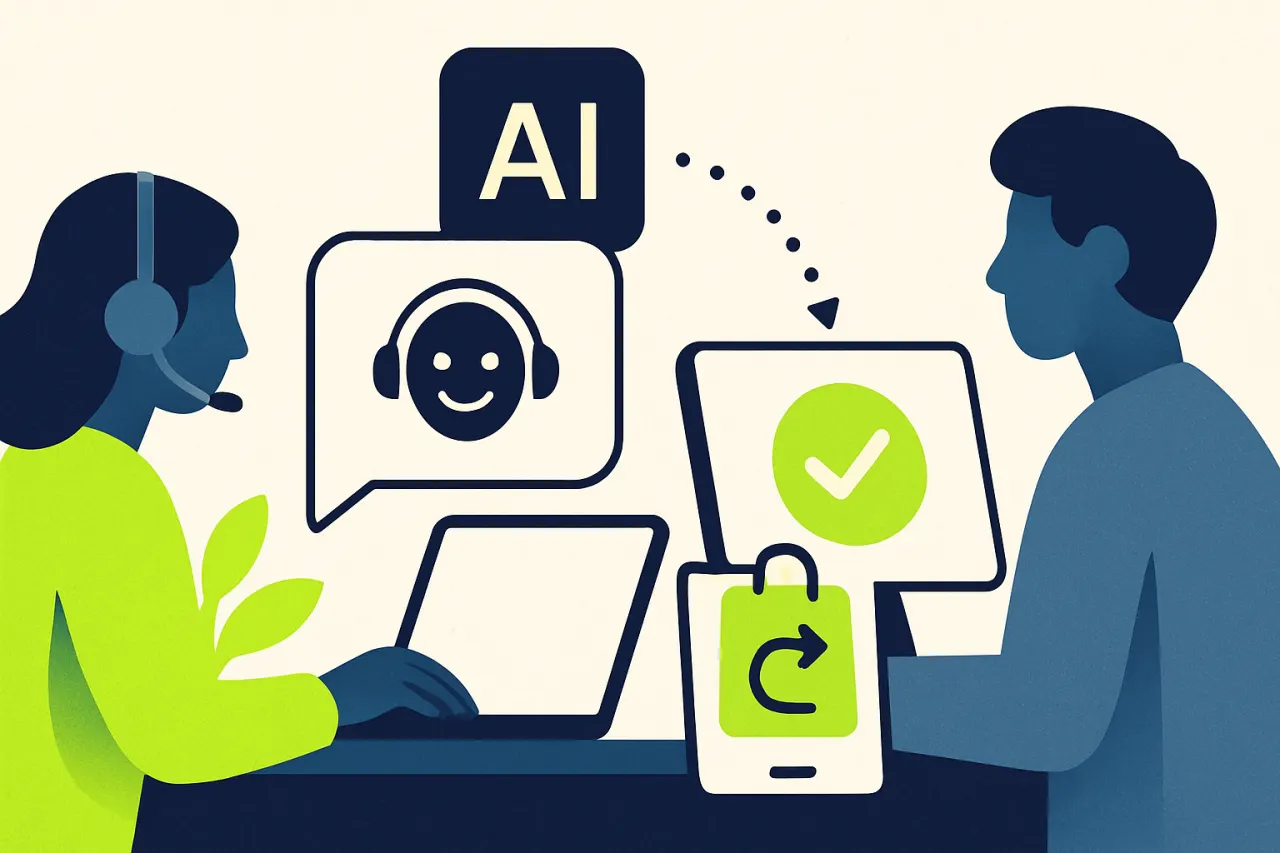
A return is not a failed sale, but a normal part of buying online. Customers order two sizes, keep one and send the rest back. Yet many webshops treat returns as if they are an exception: manual, slow and with a lot of back and forth emailing. The result is a process that grates, precisely at a moment when the customer is sensitive to how well everything is handled.
This article shows how the return process from request to refund can be largely automated with AI and workflows. The reader gets a step by step plan, learns the most common pitfalls and sees how a smooth return process actually raises customer satisfaction rather than lowering it. Not theory, but a workable approach for teams that want to speed up returns without losing control.
The direct costs of returns are visible: shipping, inspection, repackaging and sometimes markdowns. But the hidden costs sit in the handling. Every return request picked up manually costs an agent time. Looking up the order. Checking policy. Creating a return label. Informing the customer and finally setting the refund in motion. With dozens or hundreds of returns a week this adds up quickly.
On top of that, noise arises. A customer asks where their refund is while the parcel is still in transit. Another gets no label and emails three times. Yet another sends back something outside policy, after which a discussion starts. Each of these cases eats time and creates frustration on both sides.
The most painful part is that a slow return damages the relationship at the wrong moment. A customer who is helped quickly and clearly with a return often orders again. A customer who sits in uncertainty about their money for weeks does not. The way a webshop handles returns partly determines whether someone comes back.
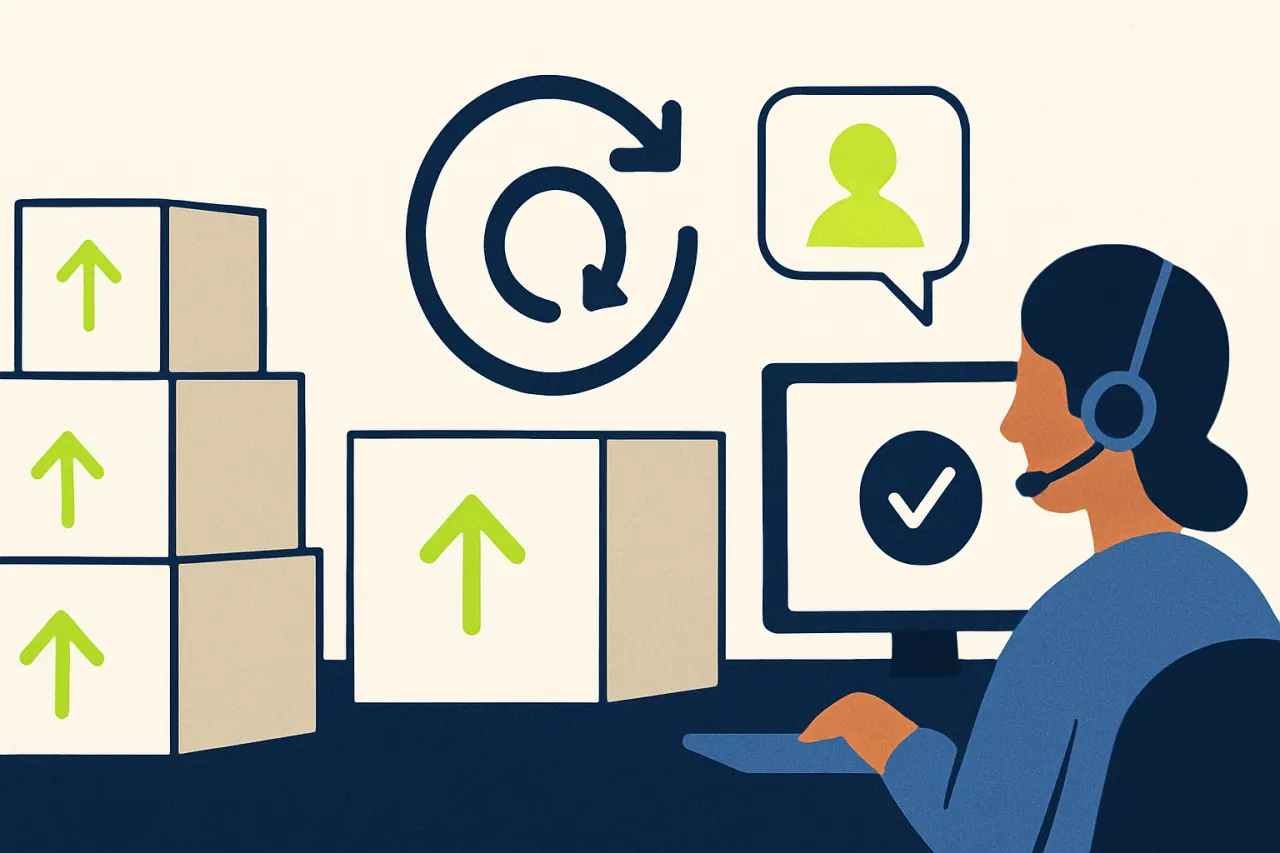
An automated return process follows the natural lifecycle of a return. Each step can be handled partly or fully by AI and workflows, with the human as a safety net for exceptions.
A return request comes in via email, chat, phone or a form on the site. The first win is that all those channels come together in one inbox, so no request is left lying around. An AI agent recognises that it is a return and links it to the right order. It also pulls in the relevant data: what was ordered, when, and whether it falls within the return window.
Not every return is allowed. The window may have expired, the product may be excluded or the reason may call for an exchange rather than a refund. A workflow tests the request against policy and determines the route. If the return fits the rules, the process continues. Edge cases are sent as a task to an agent with all context attached, so they do not have to search.
Once the return is approved, the customer should know what to do as soon as possible. A workflow generates the return label or instruction and sends it straight to the customer, with a clear explanation of packing and sending back. This is exactly the kind of action a human no longer needs to do, because the rules are fixed.
Many return questions come from uncertainty: where is my parcel, has it been received, when do I get my money. By tracking the return shipment and informing the customer automatically at every status, those questions disappear before they are asked. A proactive message when the parcel is received saves a lot of back and forth.
On receipt and inspection of the return, the refund can be started. For standard cases this can be fully automatic, for exceptions an agent's approval remains sensible. The customer gets a clear confirmation with the amount and the expected term, so there is no room for doubt.
Every return contains information. If a particular product is often sent back because the size runs off, that is a signal for the product page. By recording and analysing return reasons, the process becomes not only faster but also smaller, because the cause of returns is addressed.

Automation goes wrong when a few things are overlooked:
Automation is only valuable if it makes a measurable difference. A few numbers show whether it works. Measure the lead time of a return: how much time sits between the request and the moment the customer has their money back. If that time drops after setting up workflows, the effort pays off.
Also look at the share of returns handled fully automatically without an agent having to step in. If that share rises, the team keeps time for the cases that genuinely need attention. The reverse is informative too: if many returns land with a human as edge cases, the policy is probably not recorded sharply enough.
A final metric is the amount of repeat questions around an open return. If the where is my refund messages disappear, the proactive communication works. A well built return process not only lowers workload, but also makes visible where products or pages could be better.
A return feels like a single action to the customer. Behind the scenes it is a chain of steps. Assessing the request and checking the conditions. Creating a return label. Tracking the shipment and verifying receipt. And finally refunding or exchanging. When those steps happen manually and scattered, things stall along the way and the customer has to keep asking how it stands.
By treating a return as a workflow rather than a loose message, every step gets a fixed place and a clear status. The AI assesses whether the request falls within the conditions, automatically prepares the return label on approval and keeps an eye on the shipment. At every status change the customer is informed proactively, without an agent having to chase it each time.
The gain is not only in speed, but in predictability. An automated return flow treats every customer the same way, applies the conditions consistently and leaves nothing stuck between steps. Edge cases, such as a damaged item or a request outside the window, are routed automatically to a human with the full context attached. This keeps the exceptional work with people and the repeatable work with the system.
Returns are often seen as pure loss, but an automated return flow also yields insight. Every return is recorded with reason and context. From that a picture emerges of why products come back: wrong size, damage or deviation from expectation. That pattern is valuable information for purchasing, product pages and quality control.
A product that structurally comes back for the same reason points to a problem that can be solved at the source. A better size chart, a clearer photo or an adjusted description can reduce the number of returns before the order is even placed. This way the return flow is not only handled more efficiently, but also delivers the signals to reduce the number of returns over time.
Yes. You set the conditions yourself: the return window, the state of the product and any exceptions per category. That is the basis on which the AI assesses every request. If a return fits within the rules, the label is prepared automatically and the customer is informed. Edge cases or requests outside the conditions are routed automatically to an agent with the full context attached, so the final judgement stays with a human.
A return does not have to be a lost sale. A customer who quickly gets a label, is kept informed and sees their money back without fuss mainly remembers how well everything was handled. It is precisely at that moment that loyalty forms. A smooth return process is therefore not only a saving, but an investment in repeat purchases.
The key is to automate the predictable part and free the human for the exceptions. AI captures the request and checks policy, workflows set labels, status messages and refunds in motion. Anyone who wants to build further will find depth at where is my order, workflows with AI and e-commerce customer service.
Returns are part of selling online. The question is not whether they exist, but how smoothly they are handled. If you want to see how this works in practice, book a demo and see how a return runs largely on its own, from request to refund.
Cuego
cuego.io
Your Cue to Go.
The Customer Contact Platform where conversations, customer data, knowledge, workflows, people and AI come together. Book a 30-minute demo and see it against your own situation.
30-minute demo · then we set it up together
Rather look for yourself first? Take the free website scan
See also
Everything in Cuego connects. Discover the modules, solutions and integrations that belong with this.