Ticketing & support11 min
SLA Management: Managing and Meeting Expectations
Dec 3, 2025
A chatbot or a live agent? The question is not which of the two wins, but when you deploy which. This article offers a clear decision framework: which questions you safely automate, which require a human and how you make the handover between the two smooth so the customer is never worse off.
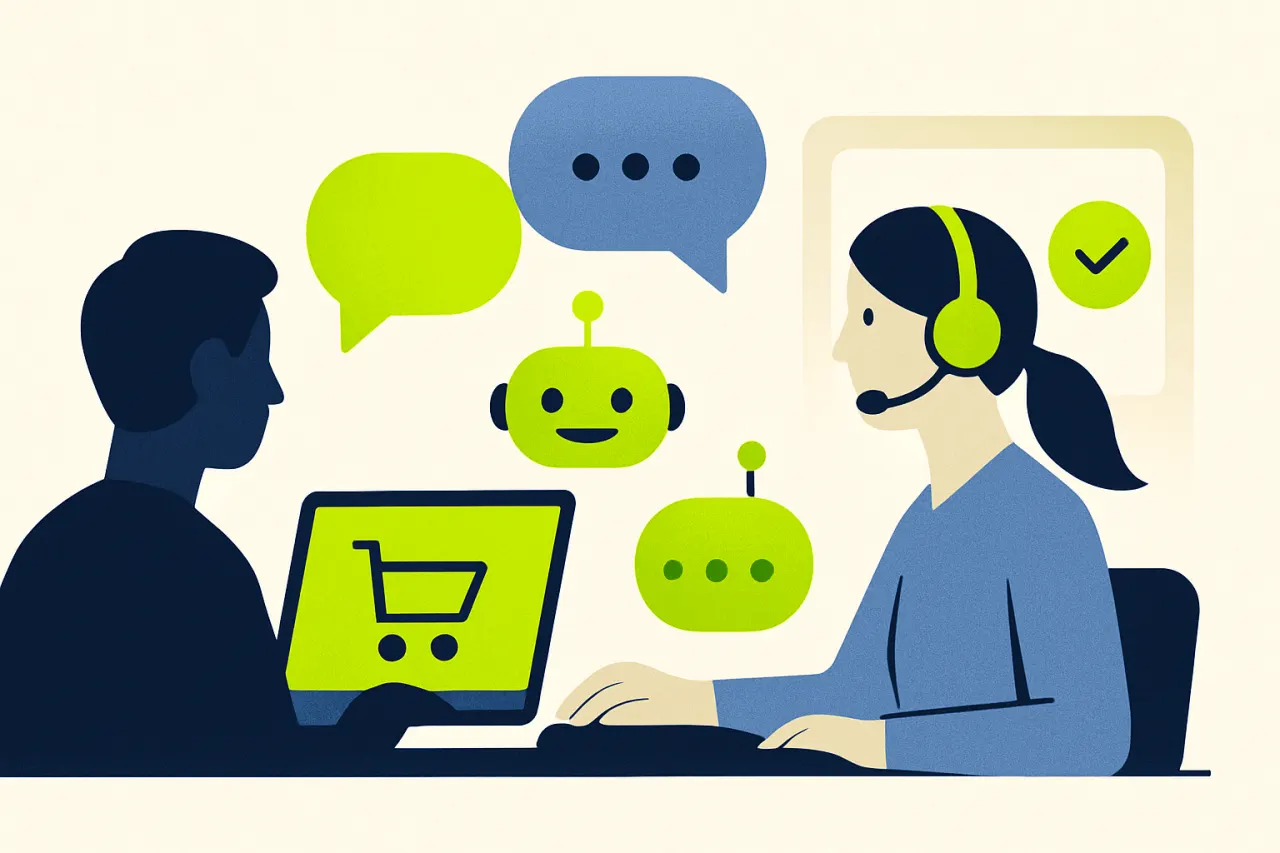
The choice between a chatbot and a live agent is often presented as a question of principle: are you for automation or for human contact. That framing is misleading. In practice it is not an either-or question but a when question. Some questions are perfectly suited to automation, others unmistakably require a human, and most service departments need both. The art is not choosing which of the two wins, but knowing which type of question belongs to which channel and how to make the transition between the two smooth.
Anyone who gets that trade-off wrong pays on two sides. A chatbot on a question it cannot handle produces frustration, repetition and eventually an angry customer. A live agent on a question that could have been answered automatically in a second wastes expensive capacity and makes the customer wait unnecessarily. The difference between a service that feels smooth and one that irritates often sits precisely in this routing: does the right question go to the right channel.
This article offers a concrete decision framework. It describes what chatbots and live agents each do well, by which criteria you classify a question, how to set up the handover from bot to human without the customer having to repeat their story, and which mistakes to avoid. The starting point is that a modern AI agent and a human reinforce rather than replace each other, provided you design the division of labour deliberately.
A chatbot, and certainly a modern AI agent, excels at volume, speed and availability. It answers a thousand questions at once, knows no queue, works day and night and gives a standard question an answer within a second. For the large stream of predictable questions, the delivery status, the return policy, the opening hours, the stock, that is an unbeatable profile. A human typing the same question for the hundredth time does so slower and at greater cost, without the customer gaining anything.
A live agent excels where judgement, empathy and tailoring are needed. A complaint that is emotionally charged, an exception to the policy, a negotiation over a goodwill arrangement or a complex problem touching multiple systems: those are situations where a human adds value no script can capture. The customer feels the difference between someone genuinely thinking along and an automated answer, precisely at the moments that matter.
The mistake many teams make is to set one profile on the work of the other. A chatbot forced to handle an emotional complaint fails predictably. A human deployed on repetitive routine work becomes overloaded and bored. The gain lies in the combination: let each do what it is good at, and ensure the transition between the two runs seamlessly. A modern AI agent makes that feasible, because it not only answers but can also judge when a question crosses its limit and belongs to a human.
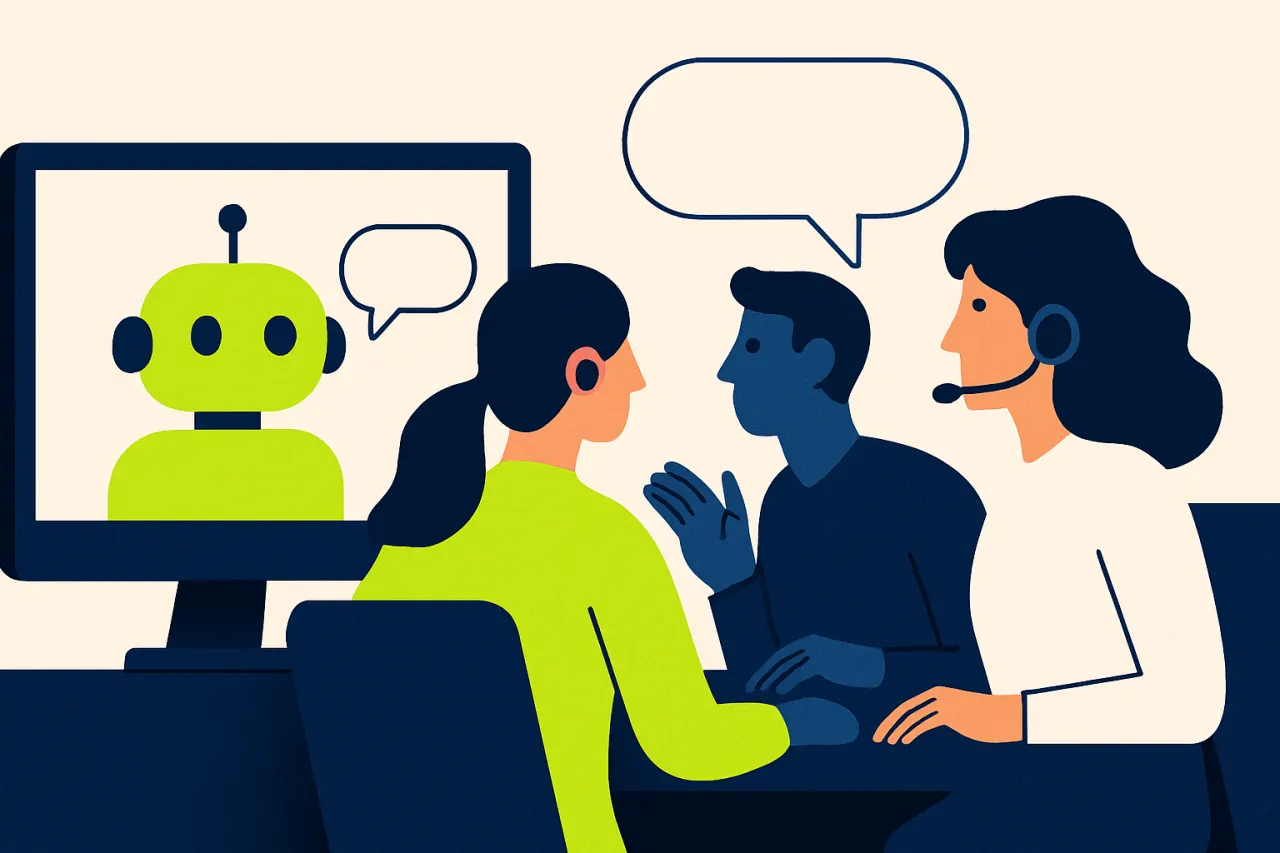
Chatbot versus live agent is a false opposition. The question is not which one wins, but which question belongs to which channel, and how the handover from bot to human runs smoothly without the customer noticing.
The following five criteria help you decide whether a question goes to the bot or to a human. They work best together: a question that raises doubt on one criterion may still be safely automated on the others, and vice versa.
The first question is whether one correct answer exists. Questions with an unambiguous answer from a source, the delivery status of an order, the return policy, the opening hours, are ideal for automation. The AI fetches the right answer from the knowledge base or a connected system and delivers it instantly. As soon as the answer depends on judgement, interpretation or an exception, the balance shifts toward a human.
In practice this means you start with the most common, most predictable questions. A question like where is my order has a factual answer the AI fetches from the order data. A question like I am dissatisfied with how this went, what are you going to do about it, does not, and therefore belongs in a different track.
Not every question is only an information question. A customer who is angry, disappointed or worried seeks acknowledgement, not just an answer. A correct but cold automated reply to an emotionally charged message can make the situation worse. That is why the emotional charge is a standalone routing criterion: even a factually simple question may be better off with a human if the customer's tone calls for it.
A modern AI agent can gauge the tone of a message and escalate based on that. A message with clear frustration or a threat to leave then goes with the full context to an employee, while the neutral questions are handled by the AI. That way you prevent automation from going wrong precisely at the sensitive moments.
The more steps, systems and considerations a question involves, the more strongly it leans toward a human. A single question with a direct answer is cut out for the AI. A problem combining multiple orders, an exception to the policy and a choice between options requires the oversight and judgement of a human. The AI can prepare such a conversation by gathering the context, but the decision belongs to someone who can weigh things up.
It helps to define in advance which composite questions you explicitly route to people. That prevents the AI from getting stuck in a conversation it cannot finish, and keeps the customer experience smooth because the right question lands in the right place straight away.
The pivot of a good system is the handover. When the AI cannot or may not handle a question, the transition to a human must feel invisible to the customer. That only works if the employee takes over the full conversation, the customer history and the context already gathered, so the customer does not have to repeat their story. A handover where the customer has to start from scratch is worse than no bot.
In concrete terms this means bot and human sit in the same workspace, with a shared history per conversation. The AI passes the conversation on including a summary of what has been discussed and which details are already known. The employee thus steps into the middle of the conversation rather than at the start, and the customer experiences a flowing line rather than a break.
Every time the AI escalates to a human is a learning moment. By tracking which questions are passed on and why, you discover patterns: a recurring question type the AI cannot yet handle, a knowledge gap in the knowledge base, or a new topic that has not yet been set up. By closing those gaps, the boundary between bot and human shifts gradually, and the AI handles more and more independently.
That way the division of labour is not a fixed line but a moving balance that grows with you. What requires a human today can, after supplementing the knowledge base, be automated tomorrow, while the complex and sensitive work stays with people. The system becomes smarter as it sees more conversations, provided you use the handovers as a signal.
The wrong deployment of a chatbot or live agent is felt by the customer immediately. The four mistakes that go wrong most often:
Whether you have divided bot and human well shows in a few numbers. The first is the automatic resolution rate: what share of the questions does the AI resolve fully on its own, without intervention. If that percentage rises without customer satisfaction falling, the boundary is shifting healthily toward more automation. If satisfaction does fall, you are automating questions that actually require a human, and the boundary must be pulled back.
The second gauge is the escalation quality. Look not only at how often the AI escalates, but also whether it does so justifiably and whether the handover runs smoothly. A healthy escalation gives a human a conversation with full context, so the customer does not have to start over. Also follow customer satisfaction per track: compare the satisfaction of conversations the bot handled with that of human conversations. That way you see whether both channels are deployed on their strength.
Improvement comes from analysing the escalations. Every conversation that went to a human tells something: was it justified because it was too complex or too sensitive, or could the AI have done it with a better knowledge base. The first confirms the right division of labour, the second points to a knowledge gap you can close. Through that analysis the boundary between bot and human stays ever more sharply tuned, and the share the AI safely handles itself grows without quality suffering.
No, most service departments need both. It is not an either-or choice but a division: the bot absorbs the predictable standard questions, people handle the complex and sensitive conversations. The gain lies in the combination and in a smooth handover between the two, not in picking a winner.
The choice between a chatbot and a live agent is not a question of principle but a routing question. Unambiguous, predictable questions go to the AI, which handles them instantly and at scale. Complex, sensitive and emotionally charged conversations go to people, who add the value there that no script can capture. The gain lies not in picking a winner, but in deliberately dividing the work and setting up the handover between the two seamlessly.
Want to let bot and human work together smartly? See the difference between an AI and a classic chatbot, how the AI agents absorb the predictable questions and how the shared inbox enables a smooth handover to people. Or request a demo and see the division of labour applied to your own questions.
Cuego
cuego.io
Your Cue to Go.
The Customer Contact Platform where conversations, customer data, knowledge, workflows, people and AI come together. Book a 30-minute demo and see it against your own situation.
30-minute demo · then we set it up together
Rather look for yourself first? Take the free website scan
See also
Everything in Cuego connects. Discover the modules, solutions and integrations that belong with this.