AI & Automation9 min
What if AI in customer service makes a mistake? Managing the risk
Aug 2, 2026
Serving an international webshop does not mean hiring a separate team for every language. This is how AI answers customers in their own language, in your tone of voice, while preserving quality and context.
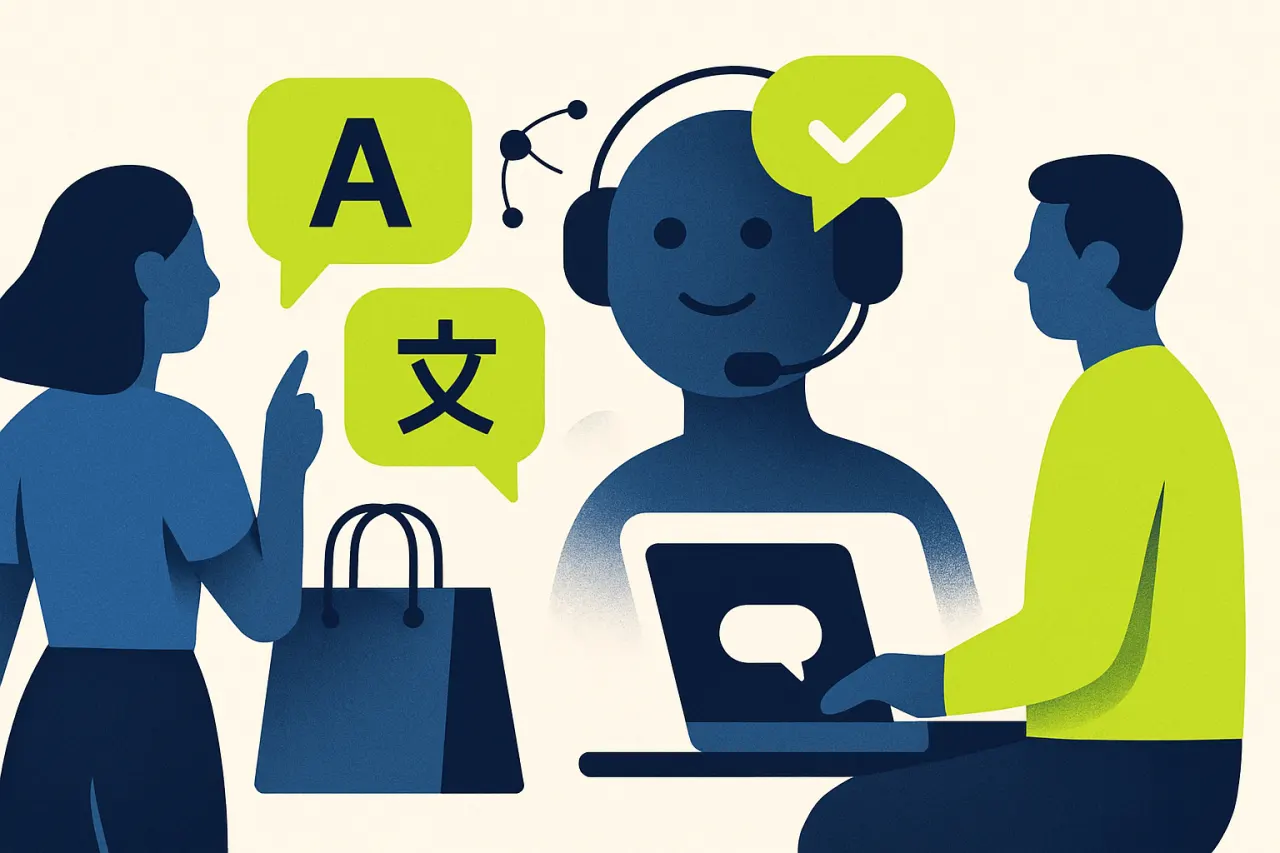
The moment a webshop crosses a national border, customer service shifts from an operational detail to a strategic challenge. An order from Germany, a returns question from France, a chat in Polish. Every language that comes in demands a reply that is correct, sounds natural and matches your brand. Multilingual customer service is therefore much more than translation. It is the question of whether a customer on the other side of Europe feels just as well helped as a customer at home.
The classic solution, hiring a native speaker for every language, scales poorly and is expensive. Translation tools that sit apart from your support system produce stiff, literal text that misses the point. This article shows how AI tackles the problem differently. It recognises the customer's language and understands the question. Then it drafts a reply in your tone of voice and returns it in the right language, with no context lost along the way.
International growth rarely stalls on the product or logistics. Far more often it stalls on service. A webshop ships to Germany or Scandinavia without effort. The moment the first German or Swedish question arrives, a choice appears that nobody makes consciously. Do we answer in English and hope for the best? Or do we let the question wait until someone has time? Both options cost revenue and trust.
The numbers behind this behaviour are consistent. Customers trust a webshop more and buy more often when service is available in their own language. A reply in a foreign language, however correct, feels like a barrier. It signals that the customer is an outsider in a shop that was really built for someone else. That feeling translates directly into lower conversion, more cancelled orders and fewer repeat purchases.
At the same time the traditional answer is unsustainable. A team covering five languages requires five kinds of recruitment, five schedules and five times the risk that someone falls ill and leaves an entire language unmanned. For most growing webshops that is not an option. The question is not whether you want multilingual service, but how you deliver it without making your organisation five times the size.
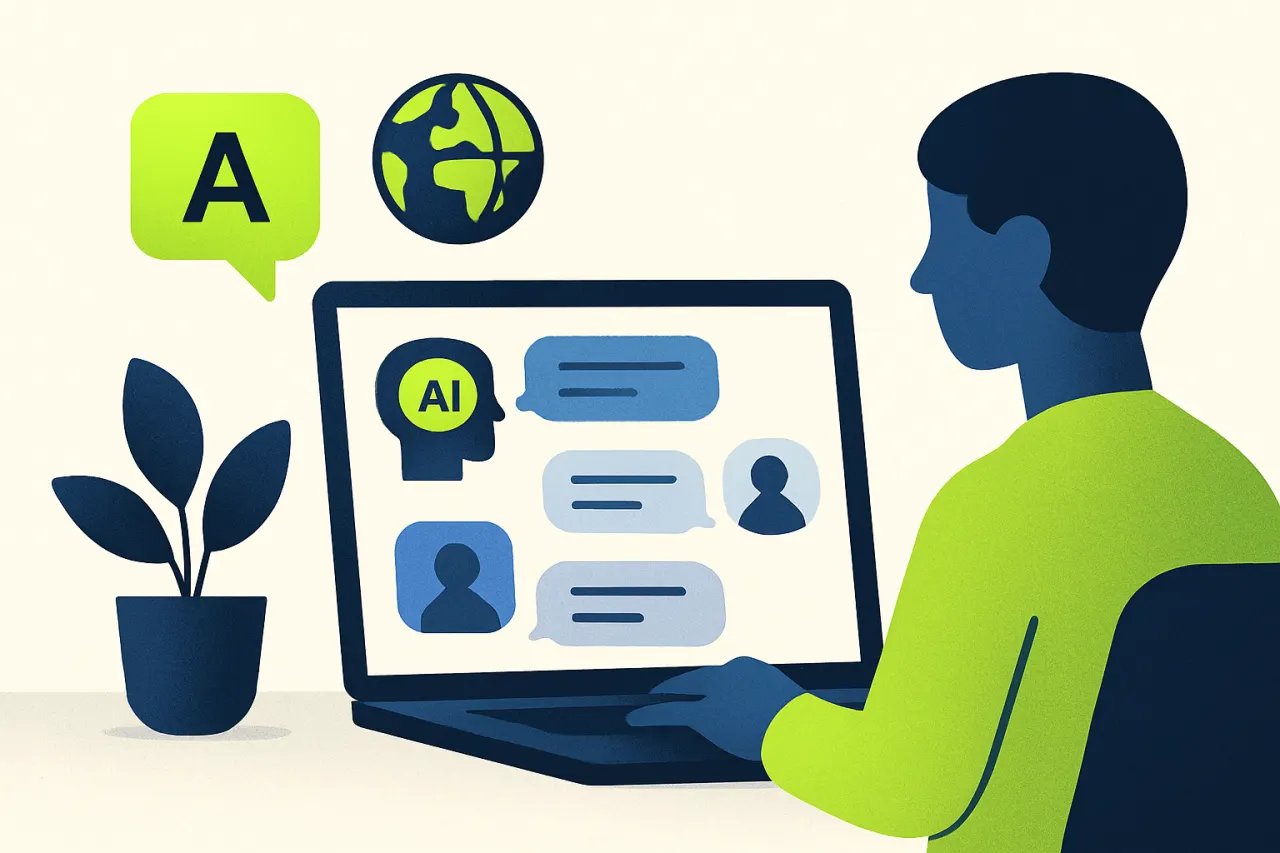
In the right setup, language is no longer something you organise per agent, but a layer that sits across your entire service. One knowledge base, one tone of voice, one set of workflows. The AI delivers all of it in the customer's language.
Good multilingual service is not a translation engine you stick onto your replies afterwards. It is a chain of steps in which language is carried along from the very first contact. The following five steps together form the framework with which a team answers in every language without sacrificing quality.
Everything starts with recognising which language the customer is writing in. That sounds trivial, but it is the step where many solutions already stumble. A reliable system detects the language from the first message, regardless of channel, and remembers that choice for the rest of the conversation. A customer who starts in French should not suddenly receive an English reply halfway through because an agent missed the language. Language detection applies across email, live chat and Cuego Telephony, so the whole conversation stays consistent.
A common mistake is to first translate the incoming question into English and only then interpret it. Nuance is lost in the process. AI that understands the question in its original language preserves the intent, the emotion and the details needed for a good answer. An irritated German customer asking for a return then receives a reply that matches both the question and the tone.
The answer comes from your own knowledge base and your own policy, never from a translated snippet of text. The AI reasons about what the correct answer is and then phrases it in the customer's language. The advantage is enormous: you maintain your knowledge only once, in one language, and the AI delivers it consistently in all languages. A change to your returns policy does not have to be updated manually in five languages.
This is where multilingual AI distinguishes itself from a translation tool. A brand that sounds warm and informal in Dutch must do the same in German and Spanish. The AI aligns not only the language but also the register: formal or informal, concise or expansive, with or without a formal mode of address. This way every reply feels as if it comes from the same brand, whether the customer is in Rotterdam or in Madrid.
Not every question can be solved with AI. For a complex or sensitive issue, an agent takes over. Crucially, that agent does not start from zero. The question, the earlier replies and the relevant order history are ready. The system also helps them answer in the right language. This keeps the human layer multilingual too, without you needing a native speaker on hand for every language.

Most multilingual setups fail on the same three points:
The biggest fear with multilingual AI is understandable. How do you know a reply in Polish or Italian is correct if nobody on your team reads that language? The answer lies not in sampling per language, but in guarding the source and the process. Because the AI reasons from a single knowledge base, you check the content in the language you do master. If the policy and information are correct at the source, the translated expression is correct too.
It also helps to follow a few concrete signals. Track the escalation rate per language. If one language stands out with many handovers, knowledge or a translation nuance is probably missing. Follow customer satisfaction per language separately, because an average across all languages hides a language that structurally underperforms. And record reopened conversations: a customer who returns in the same language with the same question signals that the first answer did not land.
You then improve at the source. Refining a knowledge article, sharpening a tone-of-voice instruction or adding a frequent question takes effect across all languages at once. That is precisely the lever that makes multilingual AI so powerful: one improvement, effect everywhere.
Multilingual service is often narrowed down to translation: a message in one language, an answer back in the same language. That is the basis, but good multilingual customer service goes further. Tone, forms of politeness and the way something is expressed differ per language and culture. A literal translation can be correct and still come across as stiff or even unintentionally blunt.
AI makes it feasible to answer in many languages without employing a separate agent for each one. The AI recognises the customer's language, answers in that same language and keeps the brand's tone of voice while doing so. For the team the work stays manageable in one language. An incoming message is summarised and translated, so an agent grasps the core and can adjust without mastering the source language.
The gain is reach without proportional cost. A webshop selling abroad can address customers in their own language from the first contact. That holds outside office hours too, and in languages where no native speaker is available. Complex or sensitive conversations still go to a person. The large stream of standard questions is handled in the right language, without scaling up again per market.
In practice the number of languages is not a limiting factor. The AI reasons from a single knowledge base and delivers the answer in the customer's language. Adding a language therefore scales along, with no new team or knowledge source. The limit lies more in how well your knowledge and tone of voice are captured than in the number of languages.
Multilingual customer service is not a matter of translating, but of understanding, reasoning and answering in the customer's language and tone. Those who treat language as a layer across the whole service rather than as a team per language cover more markets with less complexity and without sacrificing quality. One knowledge base, one tone of voice, every language.
With Cuego's AI customer service agent you answer customers automatically in their own language, fed by your own knowledge base and guarded by your own tone of voice. Want to see how that works for your international webshop? Explore e-commerce customer service or request a demo.
Cuego
cuego.io
Your Cue to Go.
The Customer Contact Platform where conversations, customer data, knowledge, workflows, people and AI come together. Book a 30-minute demo and see it against your own situation.
30-minute demo · then we set it up together
Rather look for yourself first? Take the free website scan
See also
Everything in Cuego connects. Discover the modules, solutions and integrations that belong with this.