AI & Automation10 min
Machine Learning: The Future of Customer Insights
Jan 12, 2026
AI is changing customer contact not by replacing agents, but by taking over the dull searching and the first answers. Here is how customer service shifts from reacting to orchestrating, and how to make that change safely, step by step.

Customer contact is not changing for the first time. The phone, email, live chat and the self service page each caused their own wave. What is different now is that AI does not merely add a new channel, but touches the work itself. A language model can understand a question, look up the right information and formulate an answer in plain language. That shifts the role of the agent from typing every answer themselves to guarding quality and picking up the conversations that genuinely need a human. It is not a replacement of people, but a redistribution of the work.
The heart of that change is that the routine work disappears. A large share of all customer questions is predictable. Where is my order? How do I return something? What are the opening hours, and is my invoice right? Those questions are not difficult for a human, but they are numerous and repetitive. When AI absorbs that volume, a team is left with time for the conversations that do require attention, judgement and empathy. That is the real promise: not doing the same work faster, but dividing the work differently between human and machine.
This article describes what that change looks like and why the first generation of chatbots often disappointed. Then: how a modern AI approach does work, and how to introduce it step by step. It is written for teams that do not want to be swept along by the hype, but also do not want to be left behind. The tone is sober: AI does not solve everything, but deployed in the right place it changes the daily practice of customer service profoundly and lastingly.
The reputation of AI in customer contact has been damaged by an earlier generation of chatbots. Those worked with fixed choice menus and keywords. Use exactly the right term and a pre written answer appeared. Miss it and the conversation ended in a dead end loop. Customers recognised this immediately and tried to reach a human as fast as possible. The chatbot felt like a barrier, not like help. It is therefore understandable that many teams are sceptical when the word AI comes up.
The difference with modern language models is fundamental. An old fashioned chatbot recognised patterns in text without understanding the meaning, while a modern model does understand the question, even when it is phrased differently than expected. Yet a good language model on its own is not enough. A model with no access to a customer's real data still cannot honestly answer a question like where is my order. At best it sounds friendly without saying anything useful, or in the worst case it invents an answer that is wrong.
The lesson from that first wave is therefore not that AI does not work, but that AI without context and without limits does not work. A reliable AI agent needs three things. Understanding of the question, and access to the right knowledge and data. Plus a clear boundary between what it handles itself and what it passes on. If one of those three is missing, the feeling of a chatbot that gets in the way returns. With all three present something very different emerges: a helper that handles most questions directly and correctly and hands over the rest neatly.
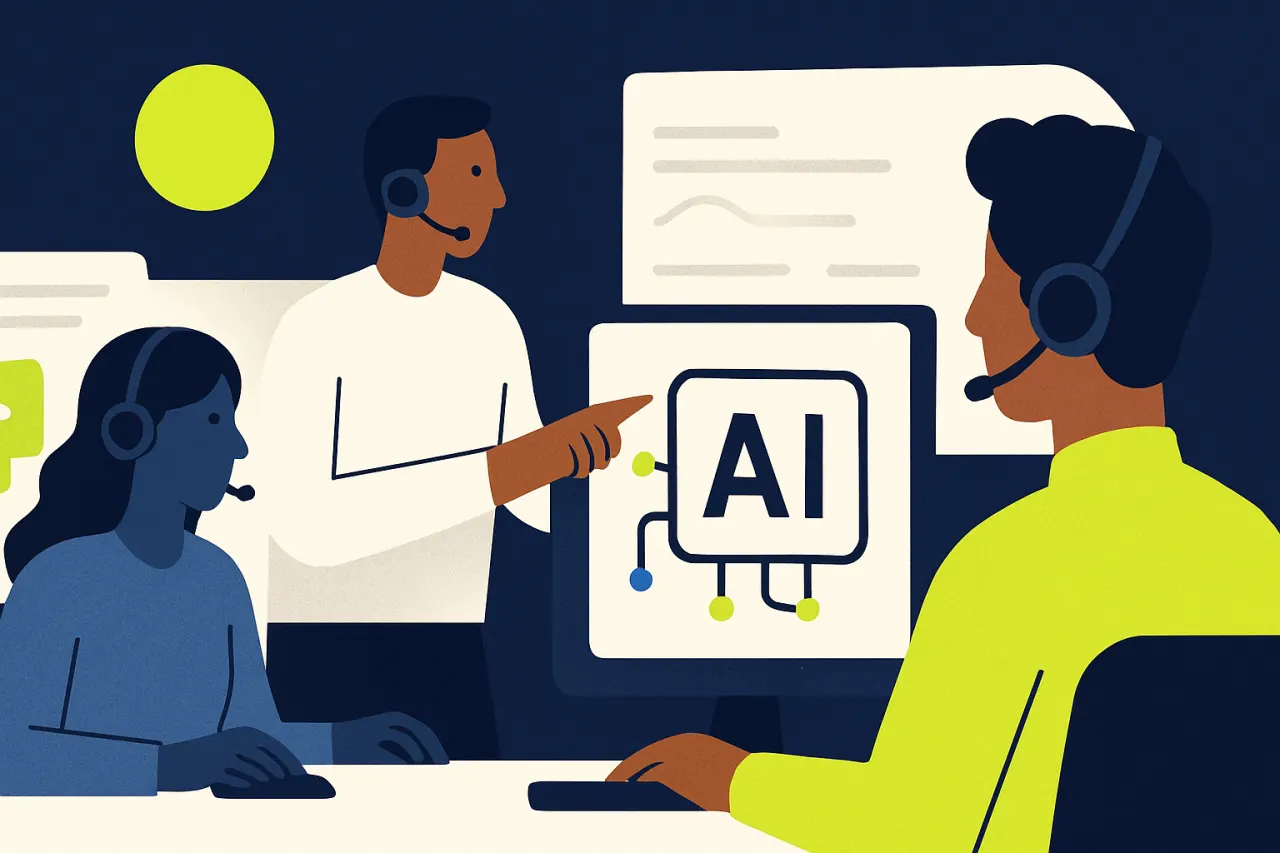
The biggest change is not in a smarter answer, but in a different division of roles. AI absorbs the predictable volume and delivers first answers. The agent guards quality, picks up exceptions and decides what the AI may do on its own. Customer service thereby shifts from reacting to everything to orchestrating the whole.
The change does not begin with technology, but with insight into what customers actually ask. Many teams have a gut feeling about the most common questions, but reality often differs. By grouping a number of weeks of conversations, a clear picture emerges: which questions come up most, which are predictable and which always require human judgement. That distinction determines where AI delivers the most.
A concrete example: a webshop discovers that forty percent of all questions concern the delivery status, followed by returns and invoice questions. Those are exactly the questions AI can handle directly with the right data. By starting with this kind of high volume and low risk question, the effect is immediately noticeable without anything risky going wrong.
AI can only give good answers if good information is available. That means an up to date knowledge base with the answers to frequent questions. It also means a connection to the systems where the real data lives, such as the webshop and the customer view. Without that foundation every model remains a smooth talker without substance. The quality of the answers is directly tied to the quality of the knowledge underneath.
In practice this means that cleaning up and completing the knowledge base is often the most important work beforehand. A question about opening hours requires an up to date answer in the knowledge base, a question about an order requires a live connection to the order data. Whoever skips this step and immediately unleashes an AI inevitably gets vague or incorrect answers and thereby confirms the old distrust.
The safest way to introduce AI is not to let it answer on its own straight away, but to let it propose drafts that a human approves. The AI reads the question, proposes an answer and the agent reviews it, adjusts it if needed and sends it. That way the team keeps full control while seeing how well the AI performs on real conversations. Trust grows on the basis of what actually happens, not on the basis of a promise.
As it turns out that the drafts for certain question types are consistently correct, you can gradually automate those categories fully. A status question that has been proposed correctly a hundred times may at some point go out without intervention. That way the boundary between human and AI slowly shifts, each time backed by evidence instead of hope.
A reliable AI approach distinguishes between giving information and carrying out actions. Answering a question based on existing data is low risk, because nothing in the world changes. Issuing a refund, cancelling an order or changing an address is high risk, because it has consequences. The rule of thumb is clear: the AI may read freely, acting runs through a controlled step or through approval.
A concrete example: the AI may tell a customer on its own that a parcel will be delivered tomorrow, because that is information. But if a customer asks for a refund, the AI creates a proposal or a task that a human confirms. That way the fast, safe answers stay automated while the decisions with consequences remain under human control.
Not every question belongs with AI. An angry customer, a complaint with emotion, a legal matter or an exceptional situation calls for a human. A good AI approach recognises those cases and hands them over neatly, including the full context of the conversation, so the agent does not have to start over. The handover must be seamless, otherwise the customer still feels passed around.
The art is not to let the AI go too far. An agent that anxiously tries to handle every question itself does more harm than good. An agent that says at the right moment that it will bring in a colleague actually builds trust. The best setup is one in which AI and human reinforce each other: the AI does the volume, the human does the cases where judgement counts.

Most failures with AI in customer contact come not from the technology, but from wrong expectations and a wrong order. The recurring pitfalls:
The temptation is strong to measure the success of AI by a single number, such as the share of questions handled automatically. That number says little on its own, because a high automation rate with many incorrect answers is worse than a lower rate with reliable answers. It is always about the combination of volume and quality. The right question is not how much the AI handles, but how much the AI handles correctly and to satisfaction.
A useful way to track this is a sample of the answers the AI gives or proposes. By regularly assessing a number of conversations for accuracy and tone, an honest picture of the real performance emerges. In addition, the number of reopened conversations is a strong signal: if a question comes back in after an AI answer, the answer was apparently not sufficient. A declining number of reopened conversations is a sign that the answers are genuinely hitting the mark.
Also watch the handover to a human. A healthy AI approach hands over the right cases and not too many or too few. If almost everything is passed on, the AI does too little. If almost nothing is, difficult cases are probably stuck with the AI when they should not be. By looking at these signals together, you know not only whether the AI works, but also where it can grow. Measuring is therefore not a check afterwards, but the steering wheel with which you shift the boundary between human and AI responsibly.
No, practice shows a redistribution of work, not a replacement. AI absorbs the predictable, repetitive volume, such as status and standard questions. Agents pick up the conversations that need judgement, empathy or a tailored approach. The role of the agent shifts from typing every answer themselves to guarding quality and handling exceptions. The work changes, it does not become superfluous.
The radical change in customer contact is not in a spectacular robot that takes over everything, but in a quiet shift of role. Customer service was reactive for a long time: waiting until a question came in and handling it as fast as possible. With AI that shifts towards orchestrating. The predictable volume is absorbed, the first answers are ready and the human focuses on the cases that really matter. That is a healthier way of working, for the customer and for the team. The gain is not only speed, but also calm and consistency.
Approach this change wisely: start small and build the foundation of knowledge and data first. Keep a clear line between reading and acting, and keep measuring whether the quality holds. That way AI is not a leap into the dark but a controlled build up. Dig deeper into what an AI customer service agent does and does not do. Read on about how a knowledge base forms the foundation under reliable answers and how AI differs from an old fashioned chatbot. And how you automate customer service step by step. Curious how this would play out for your team, request a demo.
Cuego
cuego.io
Your Cue to Go.
The Customer Contact Platform where conversations, customer data, knowledge, workflows, people and AI come together. Book a 30-minute demo and see it against your own situation.
30-minute demo · then we set it up together
Rather look for yourself first? Take the free website scan
See also
Everything in Cuego connects. Discover the modules, solutions and integrations that belong with this.