AI & Automation11 min
How AI Is Radically Changing Customer Service
Feb 13, 2026
Machine learning is shifting customer service from reactive handling to spotting patterns before they become problems. This article explains how models generate customer insights, where the limits lie and how to steer with them responsibly.
Machine learning is the part of artificial intelligence in which a system learns patterns from data instead of following fixed rules a human wrote down in advance. For customer service that is a fundamental shift. A team used to react only when a customer asked a question. Machine learning makes it possible to recognise signals in customer contact before they grow into a problem. A question type that suddenly recurs more often. A customer at risk of dropping off. A wording that points to a brewing complaint.
The promise is tempting and often overstated, so it helps to be sharp about what machine learning actually does. It does not predict the future and it does not understand customers the way a human does. It recognises patterns in large volumes of conversations, orders and behaviour, and it makes those patterns visible and steerable. That sounds sober, but it is precisely that sober capability that changes how a service team distributes its attention.
This article explains how machine learning generates customer insights and which concrete applications are possible in customer service. It also covers where the limits and risks lie, and how a team deploys the technology responsibly without losing control. The thread throughout: a model only delivers value when it rests on good data, is checked by people and is tied to a concrete action in the daily work.
Most businesses have been collecting enormous amounts of customer data for years. Conversations and emails. Orders and returns. Reviews and chat logs. The problem is rarely a lack of data but the absence of meaning. That data sits scattered across different systems, in different formats, and nobody has time to read thousands of conversations by hand looking for a pattern. The information is there, but it is unusable as long as it is not unlocked.
The result is that teams steer on anecdotes. One loud complaint in a team meeting gets more attention than a pattern that passes by a thousand times in silence. A product problem building up in the chat logs stays invisible until it escalates into a spike in returns or a string of negative reviews. The service team runs behind the facts, not out of unwillingness but because the signals lie hidden in too much raw data to oversee by hand.
This is where the real value of machine learning lies. A model can classify, cluster and summarise thousands of conversations at a scale unreachable for people. It makes visible which question types are growing, which customers show deviating behaviour and which topics correlate with lower satisfaction. Not to replace the human, but to point the human to the places where their judgement makes the most difference. Without such a layer, customer data remains an archive instead of a compass.

Machine learning is not a single feature but a collection of techniques that each yield a different kind of insight. The following five applications are the most concrete and achievable for customer service, and they build on one another from simple classification to predictive steering.
The most fundamental application is classification. A model learns from earlier human-labelled examples which type of question comes in. A status question or a return. A complaint or a product question. Once the model does that reliably, every incoming conversation is automatically placed in the right category, routed to the right person and reflected in the numbers.
The insight this delivers goes beyond routing. When all questions are classified, it becomes visible what share each question type has and how that changes over time. A webshop that sees the share of shipping questions double in a week knows something is wrong at a carrier before the first angry review appears. That is a pattern that stays invisible in individual conversations but stands out immediately in the classified stream.
A second layer is recognising the tone and the intent behind a message. A model can estimate whether a customer is frustrated, neutral or satisfied, and whether a question is urgent or not. That helps prioritise conversations: an irritated customer with a time-sensitive question deserves attention sooner than a routine question that can wait.
Importantly, sentiment is a signal, not a verdict. A model that detects frustration does not replace the human sense of nuance, but it does ensure the cases that matter most do not vanish at the bottom of a full inbox. Combined with classification, this creates a prioritisation that steers on content and tone rather than purely on order of arrival.
Where classification works with categories known in advance, clustering finds the patterns nobody had named. A model groups conversations by similarity, even without labels, and so brings to light topics the team had not yet conceived as a category. This is how a new type of question around a freshly launched product or a recurring misunderstanding about a certain condition appears.
This is valuable because most problems do not begin as a neat category but as a diffuse stream of separate questions. Clustering makes that diffuse stream visible as a coherent topic. A team can then intervene at the source: clarify a product page, add a knowledge base article or adjust a process before the volume rises further.
A more advanced application is predicting future behaviour based on historical patterns. A model can flag which customers show traits that in the past preceded leaving: declining activity, repeated complaints, an unresolved question. That is not a crystal ball but a probability estimate, which is exactly why the outcome should always be weighed by a human.
The value lies in timing. A customer about to drop off can often still be kept with a timely, personal action, while the same customer is barely winnable back after leaving. A predictive signal turns service from reactive to proactive: not waiting until the customer complains, but reaching out at the moment that makes the difference.
The fifth application makes large volumes of text manageable. A model can summarise long conversations, distil the core of hundreds of reviews and pull from the conversation history what a colleague needs to know to help further. That not only saves time but also prevents context being lost in a handover between agents or channels.
Combined with a good knowledge base, this creates a learning system. The questions that occur most often point to the knowledge gaps that most urgently need filling. The model makes visible where the knowledge base falls short, and every addition lowers the volume of repeat questions. So customer contact is not only handled but also turned into knowledge that prevents future questions.
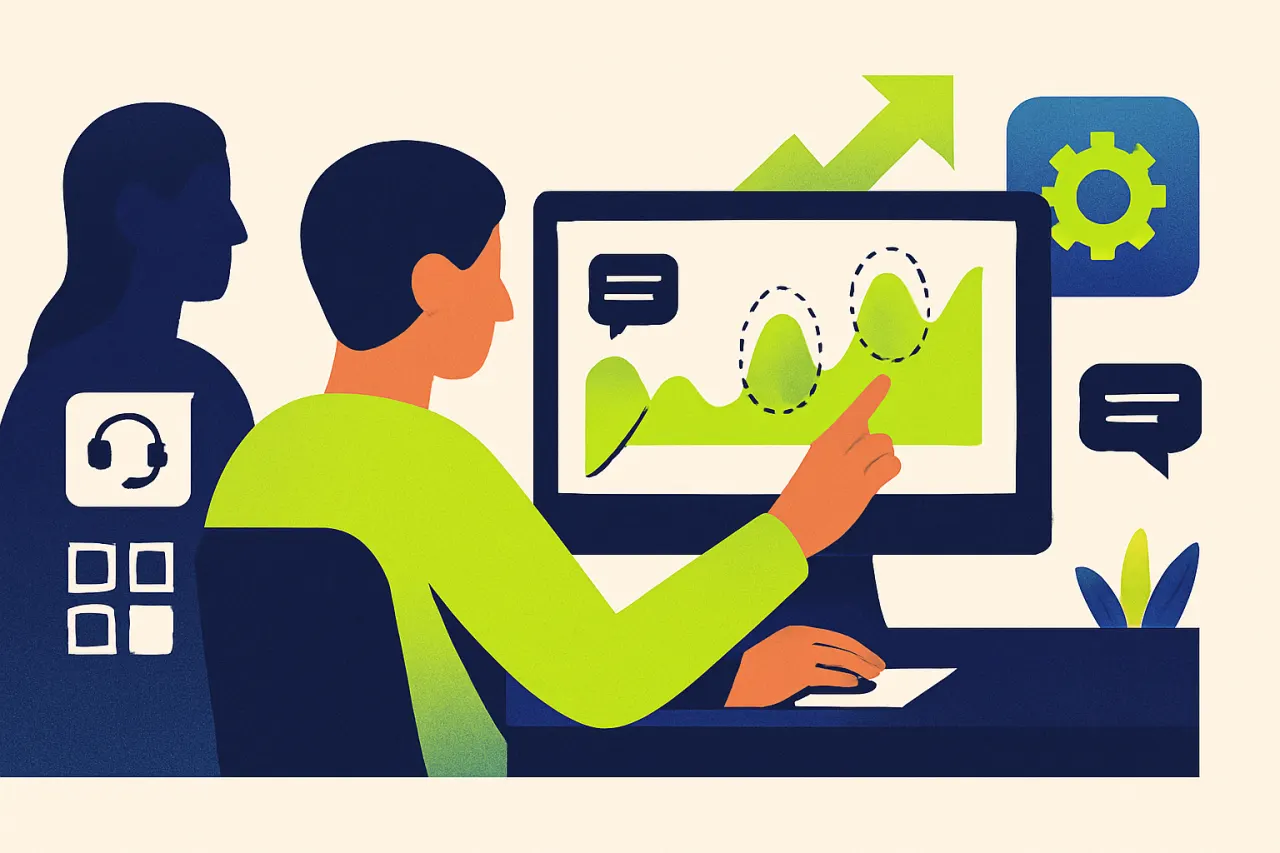
The biggest mistake when deploying machine learning is treating the model as an oracle. A model delivers a probability, not a truth, and it can err in ways that seem illogical to a human. Responsible deployment therefore starts with the rule that a model advises and a human decides, certainly as long as it concerns communication to customers or sensitive decisions. An AI-suggested answer that is approved first combines the scale of the model with the judgement of the agent.
The second condition is data quality and transparency. A model is only as good as the data it learns from: polluted, incomplete or one-sided data produces distorted insights that steer in exactly the wrong direction. Part of this is that an insight is traceable. A model that says a question is a certain category or that a customer is at risk should be able to show what that rests on. Only then can a human check and correct it. A black box without explanation undermines the trust needed to act on it.
The third condition is care with customer data. Insight from data must never come at the expense of privacy. That means data minimisation, clear retention periods, processing within the right legal frameworks and transparency to the customer about what happens with their data. Human judgement, data quality and privacy: anyone with those three conditions in order can deploy machine learning as a reliable scout. It points the team to what deserves attention, without taking control away. That is the responsible future of customer insights: not replacing the human, but directing their attention to what truly matters.
Ordinary automation follows fixed rules a human set up in advance: if this happens, do that. Machine learning learns patterns from data without every rule being written by hand, so it also recognises signals nobody had explicitly named. Both have their place: rules are predictable and transparent, models find patterns that rules miss. In practice they work best in combination.
Machine learning is no magic wand and no replacement for the service team. It is a layer that extracts meaning from the customer data a business already collects, and that makes patterns visible before they grow into problems. The value does not arise in the model itself but at the moment an insight leads to a concrete action. An adjusted product page. A timely conversation with a customer about to drop off. A knowledge base article that removes a recurring question.
Cuego uses AI to classify incoming questions and propose drafts approved by a human, fed by a knowledge base with source citation and a full customer view. This makes insight traceable rather than a black box, and keeps control with your team. Read more about the approach on the page about AI at Cuego, or request a demo to see how customer insights land in your daily work.
Cuego
cuego.io
Your Cue to Go.
The Customer Contact Platform where conversations, customer data, knowledge, workflows, people and AI come together. Book a 30-minute demo and see it against your own situation.
30-minute demo · then we set it up together
Rather look for yourself first? Take the free website scan
See also
Everything in Cuego connects. Discover the modules, solutions and integrations that belong with this.