
Growth & productivity9 min
Comparing customer service software: what actually matters?
Jul 5, 2026
Two chat software vendors can end up hundreds of euros apart on exactly the same usage. The cause is the billing unit: per user, per ticket, per resolved AI conversation or per bundle. Each model prices different behaviour, and that decides what growth costs you.
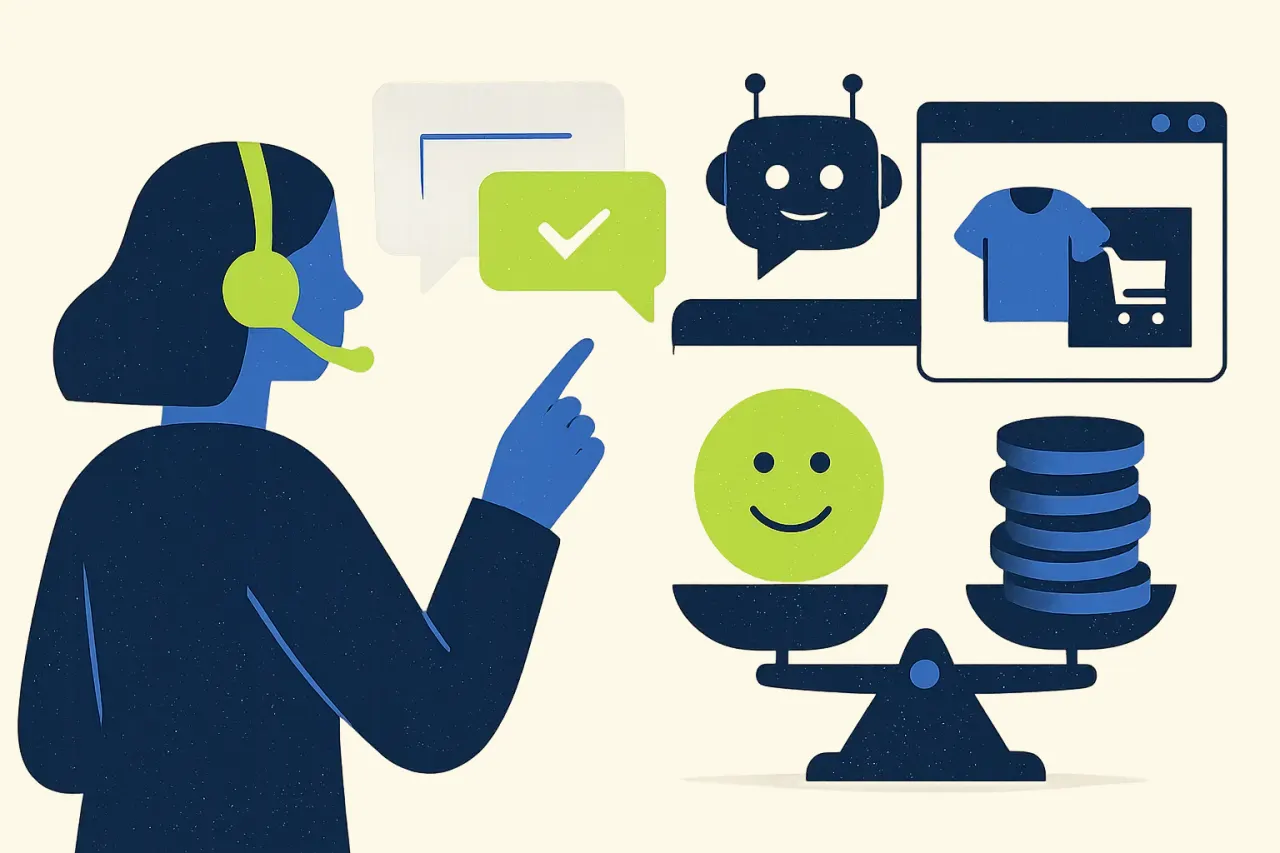
Put two quotes for chat software side by side and you'll rarely see the same unit. One charges per colleague who can log in. Another per ticket that arrives. A third only bills when the AI finishes a conversation entirely on its own. A fourth sells a bundle with a number of conversations in it. Four monthly amounts, four different things pushing that amount up.
That makes "what does a chat on my website cost" impossible to answer with a figure. It is answerable with a calculation, and that calculation has only two variables: how many conversations you get and how many people work on them. Which of the two drives up your bill is decided by the pricing model you pick.
Behind nearly every offer sits one of four units. They sound like an administrative detail, but they decide which behaviour gets more expensive as you grow.
These four are not four flavours of the same thing. They price different behaviour, and you notice that difference once you grow.
A pricing model is an incentive. You end up paying for the behaviour the unit measures, so look at which behaviour you actually plan to show.
Take a webshop that switches on chat and finds it works. More conversations come in and more colleagues start looking along. The bill climbs differently in each model.
Under per user, volume is free and people are expensive. Ten percent more conversations costs nothing extra. But the warehouse colleague who answers a stock question twice a week costs a full licence. The predictable result is that teams share accounts or keep people outside the system, and then those colleagues' answers are recorded nowhere.
Under per ticket it is the other way round. Everyone can join in, but success is expensive: every extra question your site provokes counts. A campaign that creates a rush raises your software bill exactly when things are already hard.
Under per AI resolution you pay only for automation that succeeds. That feels fair, and largely is. Do watch the definition of "resolved", because it decides your bill. A conversation the AI finishes without intervention counts, even if the customer emails afterwards anyway.
Under per bundle you know your monthly amount up front. The question is what happens when you go over it: does the vendor charge a penalty rate per extra conversation, or the same rate as inside the bundle?
You need only two figures. To work out what a question costs you internally, that calculation is in what your customer service really costs. Your chat conversations per month, and the number of people working on them. For that second figure, count the colleagues who only look in occasionally too, because that group is exactly where the models diverge.
The calculation per model:
Fill in those four with your own numbers and the differences stand out. Then run the same calculation again at double the conversations. That second round matters more than the first, because it shows what growth costs rather than what today costs.
Three items rarely appear at the top of a pricing page and often decide the difference.
AI as a separate layer. With several vendors AI isn't part of the plan but a charge on top. Freshdesk includes the first 500 sessions with Freddy AI Agent and charges per hundred sessions above that. Zendesk offers Copilot as an add-on per agent per month. Intercom puts Fin alongside the seats. So the plan total isn't your total.
Channels that only come with a higher plan. At Zendesk the entry plan covers email and ticketing, while messaging, live chat and voice arrive from the Suite level. Anyone looking only for web chat then lands on a plan largely made of things they won't use.
Connections. A chat that can look up your order status needs a link to your webshop. Sometimes that's in the price, sometimes it's a separate item. That is precisely the connection the chat derives its usefulness from, so it belongs in your calculation.
Everything above applies to any vendor. How we do it is a choice that follows from it, and it's fairer to flag that separately than to present it as a general truth.
With Cuego Chat the bundle counts AI conversations. If a colleague takes over a conversation or handles it end to end themselves, nothing comes off your allowance. The reason is an incentive: the moment taking over costs money, it becomes something you postpone. The conversations where that happens are exactly the ones where a person makes the difference.
Our rate above the bundle equals the price per conversation inside it. So a busy month carries no penalty. If you go over structurally, the next tier is cheaper by itself. Run Chat Start at 500 conversations a month. That is 99 euro plus 250 extra conversations at 0.40 euro, so 199 euro. The tier above costs 179 euro at that same volume. The sum points at itself, without anyone having to call.
This whole piece assumes you're going to grow. If your volume stays low and a small fixed team works on it, the four models sit close together in practice. At two colleagues and two hundred conversations a month, the difference is rarely big enough to dwell on.
In that case choose on something else: how quickly the chat gives a good answer, whether it can look up your orders and how easily you take over. The pricing model only becomes a real factor once one of your two numbers doubles.
Watch the term as well. An annual contract is cheaper per month with nearly every vendor. It also fixes your choice for twelve months, at a point when you don't yet know your volume. Starting monthly and switching after a quarter costs a little more and buys you a decision based on your own figures.
Ask these before you sign. The answers are rarely on the pricing page.
If you don't get an exact answer to the first question, that is information in itself. The unit is the basis of your entire bill.
Today's cheapest option is rarely the cheapest a year from now. So decide first which of your two numbers will rise. If you expect more people than conversations, pick a model that doesn't price people. If you mainly expect more conversations, watch the rate above the bundle and the definition of a unit.
Our own tiers and amounts are on the pricing page. Set that choice alongside what the chat actually needs to do. A cheap model around a chat that can't look up your order status produces conversations you end up finishing yourself.
Cuego
cuego.io
Your Cue to Go.
The Customer Contact Platform where conversations, customer data, knowledge, workflows, people and AI come together. Book a 30-minute demo and see it against your own situation.
30-minute demo · then we set it up together
Rather look for yourself first? Take the free website scan
See also
Everything in Cuego connects. Discover the modules, solutions and integrations that belong with this.